
Is Monero Mining Profitable? Full Cost and Profitability Breakdown
What is Monero and Why is it Mined?
Let’s get one thing straight: Monero isn’t just another speculative asset. I’ve always seen it as the last real stand for financial privacy in an era where every digital move is tracked. Unlike Bitcoin’s transparent ledger, Monero uses ring signatures and stealth addresses to mask the sender, receiver, and the transaction amount. It’s controversial, sure, and it makes regulators nervous, but that’s exactly why people stick with it. By early 2026, the network is consistently processing between 23,000 and 24,000 transactions daily, proving that the need for confidentiality is stronger than ever.
So, why bother mining it? The primary motivation is simple: you want to earn XMR while keeping the network decentralized. The big question most people ask is, is mining monero profitable right now? With the price sitting at roughly $338.97, the math gets interesting. Mining offers a way to acquire “clean” coins that haven’t touched an exchange or been linked to your ID. Because of the RandomX algorithm, you don’t need to hunt for specialized ASIC gear; a decent CPU in your home computer is often enough to get started. It’s an accessible way to join the ecosystem without a massive upfront investment.
How to Mine Monero: Step-by-Step Guide
Step 1: Install Mining Software
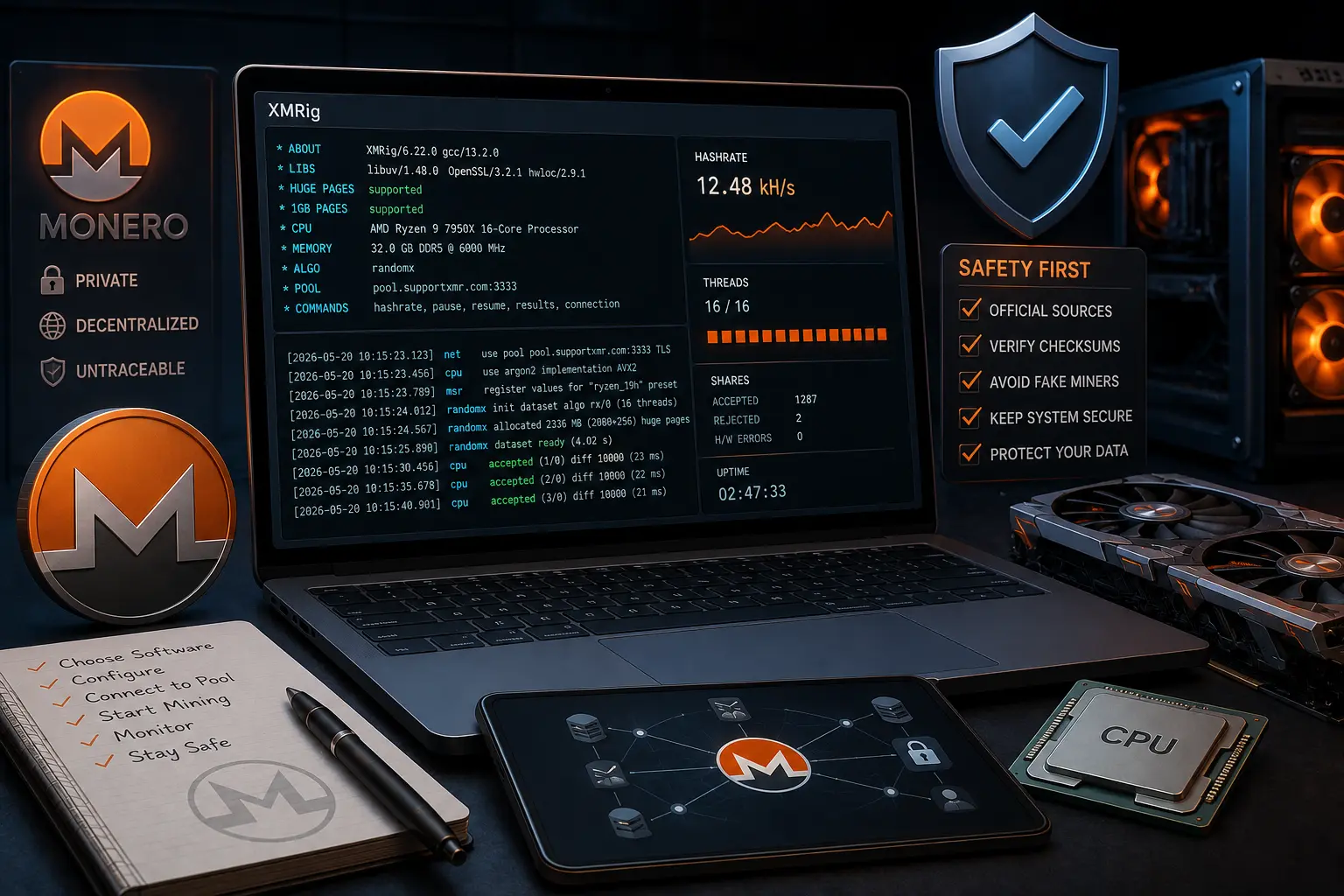
To get things moving, you need a program that handles the actual calculations. I’ve found that XMRig is the only real choice for most people in 2026. Make sure you grab it directly from the official GitHub releases. If you download it from some random third-party site, you’re basically inviting a backdoor that sends your XMR to someone else. When you unzip the folder, your antivirus will likely treat it like a plague. Don’t sweat it; this is a classic false positive for mining software. Just add the folder to your exclusions list and keep going.
Step 2: Set Up a Monero Wallet
You can’t collect rewards if you don’t have a place to store them. For a fresh start, I suggest the official Monero GUI wallet if you want the full experience, or Cake Wallet for your phone if you prefer simplicity. The most vital part? Write down your 25-word seed phrase on a piece of paper. If your hardware fails and you don’t have that phrase, your money is gone for good. There is no “forgot password” button here. And please, resist the urge to just take a screenshot and save it to your email.
Step 3: Choose a Mining Pool
Mining solo is a gamble that rarely pays off for home users. Unless you have massive computing power, you should join a pool. It’s like a cooperative where everyone shares their hashrate to find blocks faster and split the earnings. Big names like SupportXMR are solid choices, but I personally prefer P2Pool. It’s decentralized, has zero fees, and pays out directly to your wallet. If you are wondering is monero profitable mining right now, joining a transparent pool is your best bet to ensure steady, predictable returns.
Step 4: Start Mining and Monitor Results
Now for the fun part: open the config.json file in your XMRig folder and swap in your wallet address and pool link. Save it, run the application, and watch the hashes fly. You’ll see your hashrate pop up in the command window. As of February 2026, a high-end chip like the Ryzen 9 7950X should be pushing roughly 31 KH/s. Just keep an eye on your CPU temperatures. If things are getting too hot, you might need to dial back the intensity or upgrade your cooling. You want your rig to last, so don’t cook it for a few extra hashes.
What Programs are Needed for Mining Monero?
Choosing your software is that specific moment when your hardware finally gets its purpose. By 2026, the XMR mining software market has matured significantly, leaving very little room for shady, fly-by-night players. Think of the program as a bridge: it fetches tasks from the Monero network and forces your CPU to solve them. I’ve seen plenty of “revolutionary” miners come and go, but in reality, it all boils down to a couple of battle-tested tools that won’t steal your hashrate or cook your system for nothing.
XMRig: The Uncontested Leader
Ask any seasoned miner, and they’ll point you straight to XMRig. It’s the gold standard. This open-source powerhouse remains the absolute peak of performance for the RandomX algorithm in 2026. What I personally appreciate is how the developers keep patching bugs and optimizing the code for the latest CPU architectures. It’s lightweight, runs via a simple console, and is designed to squeeze every last drop out of your L3 cache. Sure, messing with a config.json file might feel intimidating at first, but it’s far more reliable than any flashy GUI with “one-click” promises.
SRBMiner-Multi: The GPU Alternative
Even though Monero is strictly CPU territory, I know people who hate seeing their GPUs sit idle. If that’s you, SRBMiner-Multi is your best bet. This software handles multiple algorithms gracefully and lets you put those graphics chips to work. Obviously, GPUs aren’t as efficient as CPUs when it comes to RandomX, but if you’re sitting on a high-end card, why not throw a few extra kilohashes into the mix? Just keep a very close eye on the ratio between your power draw and the actual XMR hitting your wallet so you don’t end up losing money.
Safety First: Avoiding Malicious Clones
Here is my golden rule: only download miners from official GitHub repositories. In 2026, the web is crawling with fakes promising “double hashrate” or “zero fees,” which are usually just wrappers for malware. Always verify the file checksums before running anything. Also, keep in mind that a running miner puts a heavy load on your OS. I wouldn’t recommend running a miner on the same machine where you do your banking or store sensitive work files unless you’re absolutely certain your security setup is bulletproof.
Cloud Mining Monero
If the idea of a buzzing, heat-spitting computer in the corner of your bedroom sounds like a nightmare, cloud mining might seem like a dream come true. Essentially, you’re renting computing power from a company that has already built massive data centers, handled the cooling, and dealt with the noise complaints. You pay a fee for a contract, and in return, you get a slice of the mined coins. It sounds like the perfect passive income, but I’d suggest you keep your guard up. In 2026, with the XMR price hovering around $338.97, the cloud mining market has become incredibly crowded, and finding a deal that actually makes sense is tougher than it used to be.
Best Services for Cloud Mining Monero
The cloud service market in 2026 is a bit of a minefield, where flashy ads often hide simple Ponzi schemes. Still, a few names have managed to stick around. NiceHash remains a go-to for many; it’s more of a marketplace where you buy hashing power from other miners in real-time. Then there’s Genesis Mining, a veteran that offers more traditional long-term contracts, though they’re frequently sold out due to high demand. My advice is always the same: before you sign anything, run the numbers yourself. Most services charge maintenance fees that can swallow 40–50% of your potential earnings, especially if network difficulty keeps climbing at its current pace.
Personally, I view cloud mining with a healthy dose of skepticism. The biggest issue is that you lose all control. If the provider decides to shut down or just “vanish” with your funds, the blockchain can’t help you. On top of that, cloud mining tends to centralize the network, which goes against everything Monero stands for. If you just want to stack XMR without touching hardware, in 2026 it’s often smarter to just buy the coins directly on an exchange. You get the same assets without the risk of being stuck with a worthless contract if the market takes a dive.
What Hardware is Needed for Mining Monero?
In 2026, Monero mining stands out as a bit of an outlier. While almost every other coin forces you to buy those loud, expensive ASICs, XMR lets you use the gear you probably already own. This is all thanks to the RandomX algorithm, which was built to favor standard CPUs and make specialized chips useless. I’ve always found this to be the most accessible way to get into crypto; you don’t need a warehouse or industrial cooling to start stacking coins.
The CPU: Your Primary Workhorse
The processor is the engine of your entire operation. If you’re looking for actual profit with XMR priced at $338.97, don’t bother with old, budget chips. In early 2026, it’s all about CPUs with massive L3 caches. The heavy hitters are the AMD Ryzen 9 7950X, pushing about 31 KH/s, and the beastly Threadripper 3990X, which hits 54 KH/s. I’ve watched people try to make it work with Intel chips, and while the i9 series isn’t terrible, AMD still holds the crown for the best hashrate-to-watt ratio.
GPUs and Why They’ve Taken a Backseat
There was a time when graphics cards ruled the mining world, but Monero changed the game. RandomX is intentionally difficult for GPUs to handle efficiently. You can certainly point your RTX 4090 at the network, but it’ll suck down way more power than a high-end CPU while delivering a fraction of the performance. I’d only suggest using a GPU if the hardware is already sitting idle and your electricity is dirt cheap. Buying a GPU specifically for XMR in 2026 is, quite frankly, a great way to lose money.
RAM and Other Essential Components
A lot of people overlook this, but Monero is incredibly sensitive to your RAM setup. You need at least 4 GB, but I’d strongly recommend 16 GB or more with high speeds and low latency. RandomX is constantly fetching data, and slow memory will bottleneck even the fastest processor. Also, don’t go cheap on your power supply. Mining is a 24/7 grind, and a low-quality PSU is a fire hazard that could take your entire rig down with it.
How Much Can Be Earned from Mining Monero?
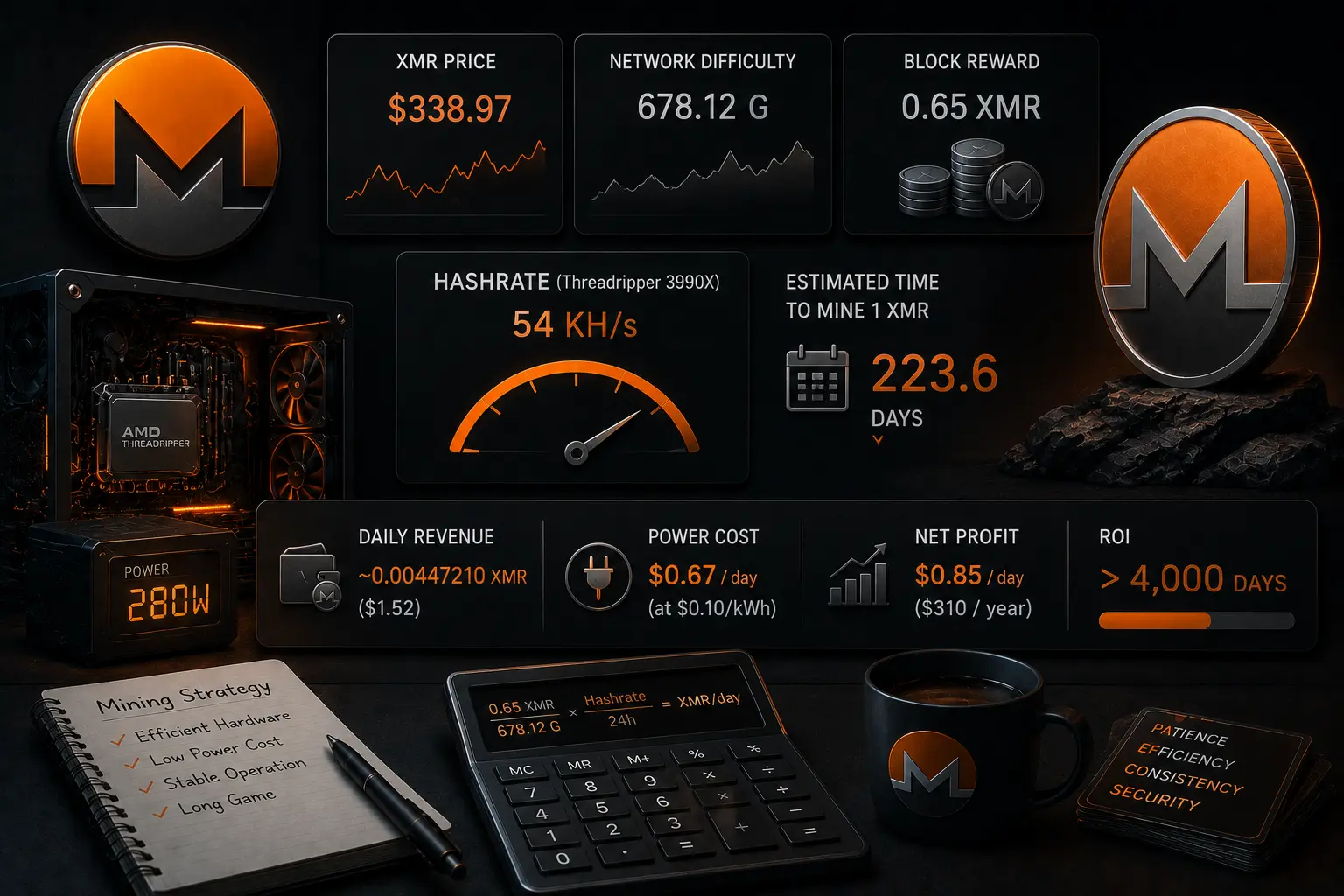
If you’re expecting a quick yacht, close this tab. In early 2026, Monero mining is a battle of margins. With XMR at $338.97 and network difficulty at 678.12 G, your earnings are a steady drip, not a waterfall. Success depends on balancing your hashrate against a block reward of 0.65 XMR.
The Math: Threadripper 3990X
Running a high-end setup (54 KH/s at 280W) yields the following:
- Daily Revenue: ~0.00447210 XMR ($1.52).
- Power Cost: At $0.10/kWh, you spend $0.67 daily.
- Net Profit: Roughly $0.85 per day ($310/year).
With an ROI exceeding 4,000 days, this isn’t a “get rich quick” scheme. At this rate, mining a single Monero takes about 223.6 days. Using mid-range gear like a Ryzen 9 7950X makes that timeline even longer.
Why Bother?
Mining XMR today is about stacking a non-KYC digital asset rather than generating high cash flow. You are essentially trading local currency for financial privacy. For many, that privacy is worth the thin margins and the long game.
Advantages and Disadvantages of Mining Monero
Mining Monero is always a trade-off between your principles and the reality of your bank account. I believe that before you hit “Start” in XMRig, you have to be honest with yourself: this won’t make you a millionaire overnight. Instead, it’s a conscious choice for those who want to support the network and earn coins without jumping through the hoops of exchange KYC. By 2026, as financial surveillance has tightened, this freedom has become a major draw that often outweighs the thin margins for many users.
The Upside: Why Miners Stick with XMR
The biggest advantage is accessibility. You don’t need to take out a loan for industrial ASIC gear; you can just run the software on your daily driver or a gaming PC. The RandomX algorithm ensures Monero stays one of the most decentralized networks because it’s secured by thousands of regular people, not just a few massive mining farms. I also see the “tail emission” as a huge win: a constant 0.6 XMR reward means miners will always have an incentive to stay online, unlike Bitcoin miners who will eventually have to rely solely on volatile transaction fees.
The Downside: Where the Plan Can Fall Apart
The elephant in the room is your power bill. If your electricity costs more than $0.15 per kWh, mining becomes an expensive hobby where you’re essentially paying out of pocket to keep your room warm. On top of that, your hardware takes a beating. A CPU grinding at 100% capacity 24/7 ages much faster than a typical office processor. Finally, there’s the regulatory heat: constant delistings from exchanges like Binance or Kraken make it harder to quickly swap your hard-earned XMR for fiat currency.
The Future of Monero Mining
Looking ahead at the rest of 2026, I don’t see Monero fading into the background. Sure, the margins are getting thinner and the competition is fierce, but fundamentally, XMR remains the only reliable tool for those who actually need financial privacy. The future of mining this coin is now tightly linked to the tug-of-war between state surveillance and technological resistance. I think we’re entering an era of “professional hobbyism,” where casual miners drop off, leaving behind those who truly grasp the value of a private asset in a world dominated by CBDCs.
Technological Progress and Hardware
On the hardware front, RandomX will keep its grip. I’m not expecting some magic ASIC to take over the network anytime soon, mostly because the Monero community has shown time and again they’ll fork the code at the first sign of centralization. CPUs will just get more efficient, and the battle will shift toward hashrate-per-watt optimization. If you’re looking to upgrade, keep an eye on chips with even larger L3 caches. I’m also seeing a spike in “green” mining setups; using excess solar power or repurposing rig heat to warm up a house is making mining monero profitable even when market prices aren’t soaring.
Regulation and Privacy Concerns
This is a touchy subject. By 2026, we’ve seen major exchanges like Binance and Kraken continue to tighten the noose, delisting XMR to satisfy AML requirements. But here’s the kicker: the more regulators push, the more demand grows on shadow markets and decentralized platforms like Haveno. I keep coming back to the idea that Monero is basically insurance. People aren’t mining XMR just to dump it for fiat tomorrow; they want an asset that can’t be frozen or tracked. As long as privacy is a human need, miners will find a way to keep the lights on.
Economic Sustainability and Tail Emission
A lot of people still miss why “tail emission” is a stroke of genius. Unlike Bitcoin, where the block reward eventually vanishes, Monero guarantees miners 0.6 XMR for every block found—forever. It creates a predictable economic floor. I’m convinced this will save the network from a security crisis down the road. Even if transaction fees stay low, that steady subsidy keeps the hardware humming. For us miners, it means that asking is monero profitable mining isn’t just about today’s $338.97 price tag; it’s about a stable payout structure for decades to come.
Published Articles
Crypto On-Ramps and Off-Ramps Explained: How Fiat and Crypto Move In and Out
Entering the world of digital assets often feels like trying to cross...
 Popular
Bitcoin Pizza Guy: The Story Behind the First Real Bitcoin Purchase
Introduction The history of Bitcoin is full of dramatic ups and downs,...

Crypto Basics Explained: A Beginner’s Guide to Cryptocurrency and Trading
Introduction The world of finance is changing right before our eyes. Just...
 Popular
Uniswap Explained: What It Is, How It Works, and How to Use the UNI DEX
Introduction Decentralization and decentralized platforms that have emerged in recent years have...
 Popular
Bitcoin Lightning Network Explained: What It Is and How Bitcoin Lightning Works
Introduction In the world of cryptocurrency, transaction speed and costs have always...

How Bitcoin ATMs Work: A Complete Guide to Using Crypto ATMs
Introduction Millions of people around the world use cryptocurrencies today – at...