
Slippage in Crypto Trading: Causes, Risks, and How to Minimize It
Introduction
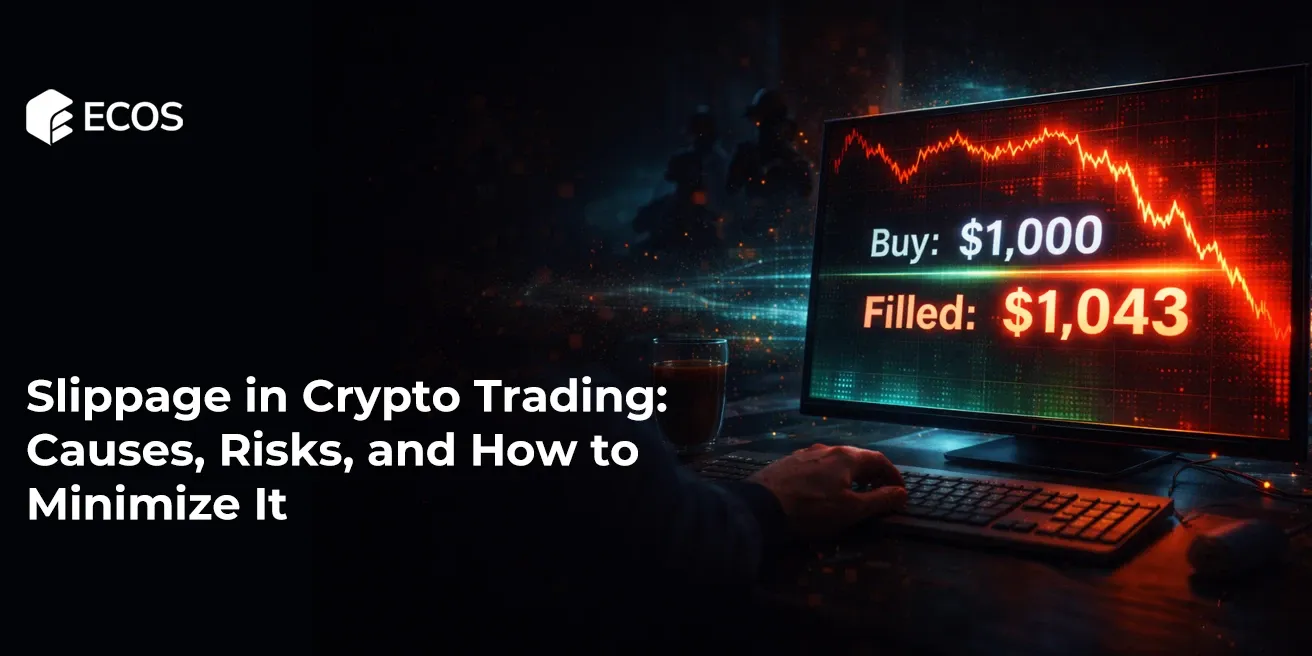
Most traders remember their first slippage shock. You place a trade at $1,000, blink, and the fill comes back at $1,043. The market didn’t crash — you just got slipped. In crypto, this happens more often, and more severely, than in traditional finance. The reasons range from thin order books to front-running bots that exist for the sole purpose of profiting off your hesitation.
This guide breaks down what slippage actually is, why it hits crypto traders harder than stock traders, and — most importantly — how to protect yourself before it costs you real money.
Understanding slippage isn’t just academic. It’s the difference between a strategy that works on paper and one that actually performs in a live account. A trading system with a 5% edge gets completely wiped out if you’re averaging 3% negative slippage per trade. For DeFi participants especially, slippage is often the single largest cost — larger than gas fees, larger than protocol fees, and far less visible than either.
What Is Slippage in Crypto Trading?
Slippage is the difference between the price you expected when placing a trade and the price you actually received when it executed. It’s not a bug, a glitch, or a scam — it’s a natural consequence of how markets work.
When you submit a market order, you’re asking the exchange to fill you at the best available price right now. But “right now” is a moving target. Between the moment you click and the moment your order hits the book, prices shift. Liquidity gets consumed. Other traders jump in front of you. The result: your fill is worse than you anticipated.
Slippage can be:
- Positive — you get a better price than expected (rare, but it happens in fast-moving markets)
- Negative — you get a worse price (far more common, and the one worth worrying about)
The formula is straightforward:
Slippage % = (Executed Price − Expected Price) / Expected Price × 100
A $5 slippage on a $50 asset is a 10% hit. On a $50,000 Bitcoin trade, even 0.2% slippage means $100 gone before the market moves a single tick in your favor.
What Does “Price Impact Too High” Mean on Uniswap?
If you’ve traded on Uniswap or any decentralized exchange (DEX), you’ve probably seen this warning pop up in red: “Price Impact Too High.” It’s not just a caution — it’s the DEX telling you that your trade will move the market against you.
Here’s why it happens. Uniswap uses an Automated Market Maker (AMM) model. Instead of a traditional order book, liquidity sits in pools — pairs of tokens locked in smart contracts. The ratio between those tokens determines the price via a constant-product formula:
x × y = k
When you buy a token, you’re taking it out of the pool and adding the other token. The more you take relative to the pool’s size, the worse your effective price becomes. A large trade against a shallow pool means massive price impact.
Common causes of “Price Impact Too High” warnings:
- Trading a low-cap token with limited liquidity
- Executing a large order relative to pool depth
- Timing your trade during low-volume hours when liquidity providers have withdrawn
The fix isn’t always obvious. You can split your order into smaller chunks, wait for liquidity to improve, or use an aggregator like 1inch that routes across multiple pools to find better pricing.
The Million-Dollar Slippage Trade Explained
In 2021, a DeFi trader lost over $1 million to slippage in a single transaction. The story became a cautionary tale that’s still cited in trading communities today — not because it was unusual, but because it illustrated exactly how preventable catastrophic slippage really is.
The trader set their slippage tolerance at 49% while trading a memecoin. In DeFi, slippage tolerance is the maximum price movement you’re willing to accept before the transaction reverts. Setting it high is sometimes necessary for thinly traded tokens — but at 49%, you’re essentially handing bots a roadmap to your wallet.
What happened, step by step:
- The trader submitted a transaction with high slippage tolerance
- MEV (Maximal Extractable Value) bots detected the pending transaction in the mempool
- The bots executed a sandwich attack: buy before the trade, sell after it
- The trader’s transaction filled at the worst possible price within their tolerance range
- The bots pocketed the difference — more than seven figures
This isn’t hacking. It’s a known, legal-in-the-DeFi-sense exploit of how public mempools work. The trader’s funds were used against them by automated programs that do this thousands of times per day.
The lesson: high slippage tolerance is not just a setting — it’s an invitation.
Why Memecoins Are Especially Risky
Memecoins amplify every risk factor associated with slippage. They combine thin liquidity, extreme volatility, and a community of traders who move in herds — a recipe for some of the worst fills in crypto.
When a memecoin goes viral, hundreds of traders rush in simultaneously. Order books (on CEXs) get overwhelmed. Liquidity pools (on DEXs) get drained within minutes. Anyone buying into the frenzy faces compounding slippage: the token price is already spiking, and their own buy order is making it worse.
Why trader loses to slippage memecoin situations are so common:
- Pool liquidity is often just a few thousand dollars — a $5,000 buy can move the price 10–20%
- Launch windows are deliberately narrow, forcing fast decisions
- Many memecoins have tax on buy/sell baked into the contract, adding another 5–15% on top of slippage
- Bot activity is disproportionately high on trending tokens
The uncomfortable truth: most retail traders who “missed” a memecoin pump weren’t actually late. They paid 15–30% more than they thought due to slippage and token taxes, then sold at a similar disadvantage. The house always wins — in this case, the house is an MEV bot running on a server three feet from the validator.
Slippage vs Price Impact: What’s the Difference?
These two terms often get used interchangeably, but they describe different phenomena.
| Slippage | Price Impact | |
| Cause | Market movement between order placement and fill | Your own order size moving the market |
| Where it occurs | CEX and DEX | Primarily DEX (AMM-based) |
| Predictability | Hard to predict | Calculable before execution |
| Control | Limit orders reduce it | Split orders reduce it |
Slippage is external — the market moved against you. Price impact is internal — you moved the market against yourself.
On a centralized exchange like Binance or Coinbase, price impact is usually negligible unless you’re trading a low-liquidity pair or moving very large size. On a DEX, it’s a primary cost to factor into every trade.
When Uniswap shows you a “1.8% price impact” before you confirm, that’s not a warning about market conditions — it’s telling you that your specific transaction will cost you 1.8% on top of whatever fees you’re paying. Both slippage and price impact stack, which is why DEX trading on illiquid tokens can quietly eat 20–30% of your capital.
How to Avoid Slippage Disasters
There’s no way to eliminate slippage entirely — but it’s very controllable with the right habits.
- Use limit orders instead of market orders — A limit order specifies the exact price you’re willing to pay. If the market doesn’t reach that price, the order doesn’t fill. You might miss some trades, but you’ll never be surprised by a 5% worse fill.
- Set slippage tolerance intelligently on DEXs — For established tokens with deep liquidity (ETH, WBTC, stablecoins), 0.5% is sufficient. For mid-cap tokens, 1–2% is reasonable. For memecoins, anything above 5% puts you in sandwich-attack territory.
- Trade during high-liquidity hours — Crypto markets don’t close, but liquidity does fluctuate. Asian and US market overlaps (roughly 8–11 AM EST) tend to have the deepest order books on major pairs.
- Break large orders into smaller pieces — On a DEX, splitting a $50,000 trade into five $10,000 tranches dramatically reduces price impact. Tools like Paraswap and 1inch do this automatically.
- Use DEX aggregators — Aggregators route orders across multiple pools and protocols to find the best available price. For any trade over $5,000 on a DEX, using an aggregator rather than going directly to Uniswap is standard practice.
- Check pool depth before trading — On Uniswap, you can view the liquidity depth chart before confirming. If the pool has $200,000 in liquidity and you’re trading $20,000, expect significant price impact.
- Consider private mempools for large trades — Services like Flashbots Protect route your transaction directly to validators without broadcasting to the public mempool. This eliminates the sandwich attack vector entirely.
Slippage in Centralized vs Decentralized Exchanges
The mechanics of slippage differ significantly depending on where you’re trading.
Centralized Exchanges (CEX) — Binance, Coinbase, Kraken
CEXs use traditional order books. Buyers and sellers post limit orders; market orders consume the best available liquidity. Slippage occurs when your market order moves through multiple price levels to fill completely.
On liquid pairs (BTC/USDT, ETH/USDT), slippage on a retail-sized order is typically under 0.1%. The real risk on CEXs is during high-volatility events — flash crashes, major news, liquidation cascades — when spreads widen dramatically and order books thin out instantly.
Decentralized Exchanges (DEX) — Uniswap, Curve, PancakeSwap
DEXs operate without order books. Liquidity is provided by users who deposit token pairs into pools and earn fees. The AMM formula determines pricing automatically.
This creates a structural slippage floor that doesn’t exist on CEXs. Every DEX trade has some price impact by definition — the question is how much. On heavily traded pairs like ETH/USDC on Uniswap v3, the impact on a $10,000 trade might be 0.01%. On a newly launched token, the same $10,000 could represent 20% of the entire pool.
The other DEX-specific risk is transaction timing. Unlike a CEX where your order fills in milliseconds, a DEX transaction gets included in a block. During network congestion (common during bull markets), your transaction might sit in the mempool for minutes — plenty of time for market conditions to shift and for bots to notice your pending trade.
It’s also worth noting that gas costs on Ethereum can interact with slippage in subtle ways. During periods of high congestion, traders sometimes set aggressive gas prices to ensure faster inclusion — but this also increases visibility to MEV bots. Using a private RPC endpoint breaks this dynamic entirely.
For most retail traders, the practical recommendation is to use CEXs for larger trades on liquid assets, and DEXs primarily for tokens that haven’t yet listed on centralized platforms. When you do use DEXs, aggregators should be the default, not the exception.
Conclusion
Slippage is one of those costs that experienced traders account for automatically and beginners often don’t see coming. It’s not dramatic — no alarms go off, no error messages appear — but it quietly erodes returns on every trade you make.
The good news: it’s manageable. Understanding the difference between slippage and price impact, respecting DEX liquidity limits, using limit orders where possible, and keeping slippage tolerance tight on decentralized exchanges will protect you from the worst outcomes. The million-dollar slippage trades don’t happen to people who check pool depth and keep their tolerance at 1%.
Markets will always move. The edge comes from knowing which movements are unavoidable and which ones you caused yourself.
FAQ
What is a good slippage tolerance for crypto trading?
For major tokens on DEXs (ETH, WBTC, stablecoins), 0.5% is standard. For mid-cap altcoins, 1–2% covers most scenarios without exposing you to sandwich attacks. Anything above 5% should prompt you to reconsider the trade or split it into smaller parts.
Can slippage be positive?
Yes. Positive slippage occurs when your order fills at a better price than expected — typically during fast-moving markets when prices spike favorably between your order placement and execution. It’s less common than negative slippage but does happen.
Why does “price impact too high” appear on Uniswap?
Uniswap displays this warning when your trade represents a significant portion of the available pool liquidity. It means your own order will move the price against you by the displayed percentage. The solution is to split the order, wait for more liquidity, or use an aggregator.
How do MEV bots cause slippage?
MEV (Maximal Extractable Value) bots monitor pending transactions in the public mempool. When they spot a large trade with high slippage tolerance, they execute a sandwich attack: buy before your transaction, then sell immediately after. Using private RPC endpoints (like Flashbots Protect) prevents this.
Is slippage worse on DEXs or CEXs?
Structural price impact is a DEX-specific issue due to the AMM model. CEXs generally offer tighter spreads on liquid pairs. However, during extreme volatility events, CEX slippage can exceed DEX slippage on major pairs as order books empty out. For low-cap or newly launched tokens, DEX slippage is almost always worse.
What’s the difference between slippage and fees?
Fees are fixed and transparent — a 0.3% swap fee on Uniswap is predictable and consistent. Slippage is variable and depends on market conditions and order size. Both costs stack, which is why it’s important to calculate the total cost of a DEX trade, not just the fee.
Published Articles
 Popular
MetaMask Wallet Explained: How to Set Up and Use It Safely
Introduction MetaMask is one of the most widely used crypto wallets in…
 Popular
What is copium? Meaning, origin, and use in crypto
Introduction I remember the first time I saw that meme of Pepe…
 Popular
Polymarket Explained: How the Crypto Prediction Market Platform Works
Introduction I’ve been watching the rise of prediction markets for a while,…
 Popular
Phantom Wallet Explained: What It Is and How to Use It
Introduction I remember when managing crypto across different blockchains felt like a…

Cryptocurrency Faucets: How They Work and How to Start Earning
I clearly remember that skeptical feeling when I first heard about “free…
 Popular
Is Monero Mining Profitable? Full Cost and Profitability Breakdown
What is Monero and Why is it Mined? Let’s get one thing…