
Stratum V2: Next-Generation Mining Protocol
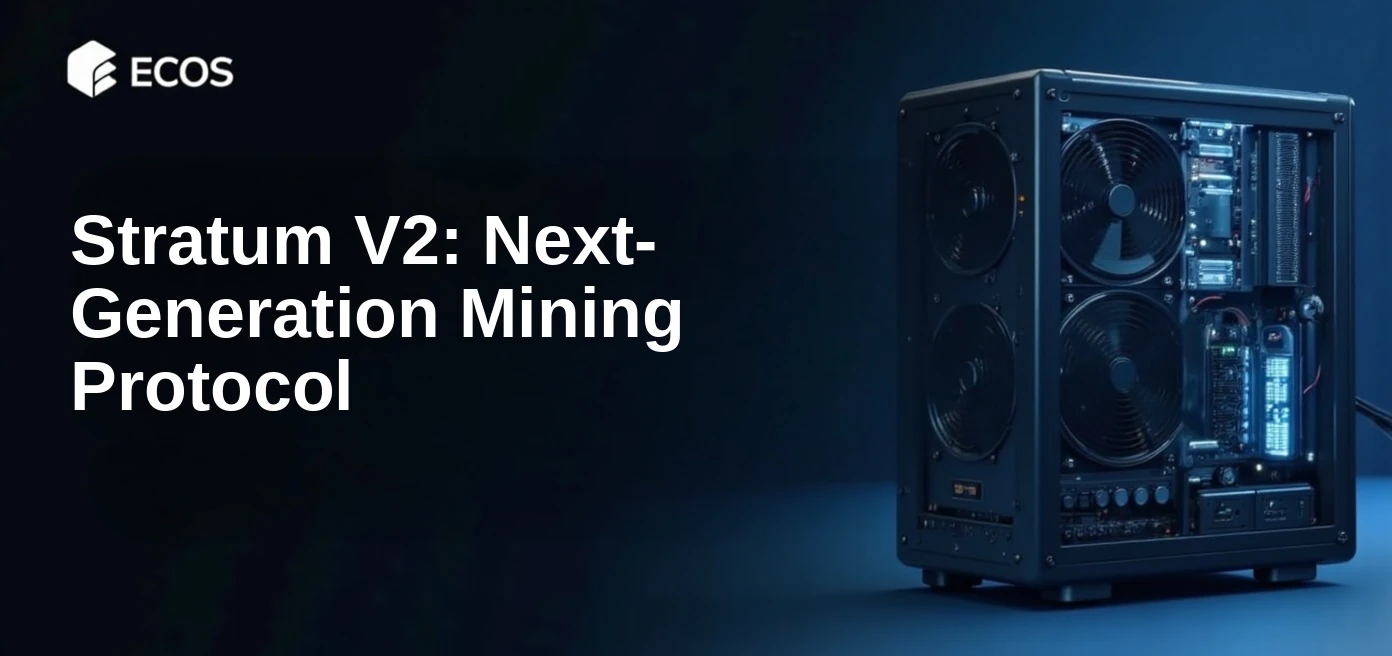
Stratum V1 has powered Bitcoin mining pools since 2012, but its limitations are showing. Stratum V2, developed by Braiins and adopted industry-wide, brings dramatic improvements: 30% bandwidth reduction, native encryption, and most importantly, transaction selection decentralization. Here’s what miners need to know about this protocol upgrade.
Stratum V1 Limitations
The original Stratum protocol served the industry well for over a decade, but modern mining operations have outgrown it:
Security Issues
- No encryption: All communication is plaintext, vulnerable to man-in-the-middle attacks
- Hashrate hijacking: Attackers can intercept and redirect your mining power
- Privacy concerns: Pool operators can see detailed profitability of each miner
- Credential exposure: Worker names and pool credentials transmitted in clear
Efficiency Problems
- JSON encoding: Text-based protocol is wasteful (typical message: 250-400 bytes)
- No compression: Redundant data transmitted repeatedly
- Chatty protocol: Excessive back-and-forth communication
- Poor scaling: Large operations (1000+ ASICs) overwhelm network infrastructure
Real impact: A 1,000-miner farm on Stratum V1 generates ~50 GB of network traffic daily. This costs money in bandwidth and creates points of failure.
Centralization
The biggest issue: pools control 100% of transaction selection.
- Miners are blind executors with zero input on block contents
- Pools can censor transactions arbitrarily
- No way to verify pool is maximizing your earnings
- Contributes to centralization concerns in Bitcoin
Stratum V2 Improvements
1. Encryption (Critical Security Upgrade)
Stratum V2 implements AEAD (Authenticated Encryption with Associated Data) as the encryption standard:
- End-to-end encryption: All pool communication encrypted
- Authentication: Prevents unauthorized access and impersonation
- Forward secrecy: Past communications remain secure even if keys compromised
Security Comparison
Stratum V1: ISP, network administrators, or attackers can see:
- Your pool credentials
- Worker names and hashrate
- Earnings and share submissions
- Can redirect or steal hashrate
Stratum V2: All traffic encrypted:
- Cannot see credentials or earnings
- Cannot hijack hashrate
- Authentication prevents impersonation
- Enterprise-grade security standard
2. Bandwidth Optimization
Stratum V2 uses efficient binary protocol instead of text-based JSON:
- Binary encoding: Reduces message size by 50-70%
- Compression: Built-in compression for repeated data
- Header reduction: Optimized packet headers
- Job templates: Send differences only, not full block templates
Result: 30% total bandwidth reduction
Why this matters:
- Large farms: Save thousands in monthly bandwidth costs
- Satellite connections: Mining viable in remote locations
- Mobile mining: Reduces cellular data usage
- Reliability: Less data = fewer transmission errors
Example (1,000 miner farm):
- V1: 50 GB/day = 1,500 GB/month
- V2: 35 GB/day = 1,050 GB/month
- Savings: 450 GB/month at ~$0.10/GB = $45/month saved
3. Job Negotiation (Decentralization)
The revolutionary feature: miners can propose their own block templates.
How it works:
- Pool sends header-only mining job (no transaction list)
- Miner constructs own block template with chosen transactions
- Miner mines on self-created template
- If block found, pool validates and broadcasts
Benefits:
- Censorship resistance: Miners can include transactions pools might reject
- Fee optimization: Advanced miners can optimize transaction selection themselves
- Decentralization: Reduces pool power over Bitcoin consensus
- Transparency: Verify pool isn’t manipulating block contents
Important: This is optional. Most miners will use pool-provided templates (easier). But the option exists for those who want control.
4. Connection Pooling
Multiple devices can share a single encrypted connection:
- Proxy support: One server handles 1,000+ ASICs
- Reduced overhead: Less load on pool servers
- Better scaling: Large farms more efficient
- Fallback: If proxy fails, ASICs can connect directly
Decentralization Benefits
Stratum V2’s job negotiation addresses one of Bitcoin’s biggest concerns: mining pool centralization.
The Problem (Stratum V1)
Top 5 pools control ~72% of Bitcoin hashrate (December 2025). Under V1:
- These 5 pools decide contents of 72% of all blocks
- Could collude to censor specific transactions
- Miners have zero say in transaction selection
- Potential threat to Bitcoin’s censorship resistance
The Solution (Stratum V2)
With job negotiation enabled:
- Individual miners decide transaction selection
- Pools become pure coordination services
- 72% hashrate ≠ 72% transaction control
- Censorship becomes practically impossible
Real-world impact: If government pressures pools to censor certain transactions, miners using V2 can simply include them anyway. Pools lose their gatekeeping power.
Adoption Timeline
Current State (December 2025)
- Braiins Pool: 100% Stratum V2 (pioneered the standard)
- Major pools with V2 support: ECOS Pool, F2Pool, Foundry USA (testing)
- ASIC firmware: S21 series fully V2 compatible, S19 XP via firmware update
- Adoption rate: ~15-20% of network hashrate using V2
2026 Projections
- Q1-Q2 2026: All major pools announce V2 support
- Q3 2026: V2 becomes default for new ASIC shipments
- End 2026: 40-60% of network on Stratum V2
Long-term (2027+)
- V1 gradually deprecated
- V2 becomes universal standard
- Job negotiation increasingly common for large miners
Should You Switch to Stratum V2?
YES, Switch Immediately If:
- Operating 50+ miners: Bandwidth savings justify effort
- Security-conscious: Encryption protects your operation
- Large-scale (1+ PH/s): Job negotiation gives optimization control
- Remote/expensive internet: 30% bandwidth reduction matters
- Future-proofing: V2 will eventually be mandatory
NOT URGENT If:
- Small operation (<10 miners): Minimal practical difference
- Happy with current pool: V1 works fine if pool is efficient
- Firmware limitations: Older ASICs may not support V2
Bottom line: Both protocols work. V2 is objectively better but V1 isn’t broken. Transition at your convenience, but V2 is the future.
How to Enable Stratum V2
For ECOS Pool Users:
- Check firmware: S21 series = native V2. S19/older may need update
- Pool URL: stratum+tcp://v2.ecos.am:3334 (V2-specific port)
- Worker config: Same as V1 (username.worker_name)
- No authentication changes: V2 handles encryption automatically
Note: Your miner will auto-negotiate encryption with pool. No manual certificate setup required.
For Large Operations:
Consider running a Stratum V2 proxy:
- Install proxy software (e.g., stratum-v2-proxy)
- Proxy connects to pool via V2
- All miners connect to local proxy
- Benefits: Single encrypted tunnel, reduced pool load, easier management
The Future: Beyond V2
Stratum V2 is not the final evolution. Future developments:
- Lightning integration: Instant micropayments for shares
- Advanced job negotiation: Miners form sub-pools with custom consensus rules
- Cross-pool collaboration: Miners on different pools share hashrate dynamically
- Zero-knowledge proofs: Prove work without revealing strategy
Mine with Stratum V2 Support
ECOS Pool offers full Stratum V2 compatibility
Experience 30% bandwidth savings + enterprise encryption
More Questions
Not directly—both protocols pay you the same for valid shares. The benefits are indirect: 30% bandwidth savings reduce operational costs for large farms, encryption prevents hashrate hijacking (which could steal your earnings), and lower latency from binary encoding can slightly reduce stale shares. For a small operation, the earnings difference is negligible. For large operations (100+ miners), the combined savings in bandwidth, security, and efficiency can add up to thousands of dollars annually
V1 works but has real security risks. Your pool credentials and earnings data transmit in plaintext, meaning anyone on your network path (ISP, network administrators, attackers) can see them. More concerning, sophisticated attackers can perform hashrate hijacking—redirecting your mining power to their own pool. If you’re on a trusted network and use a reputable pool, V1 is functional. But if you’re security-conscious or operate at scale, V2’s encryption eliminates these vulnerabilities entirely
Job negotiation lets miners construct their own block templates instead of accepting whatever the pool provides. This matters for Bitcoin’s decentralization—it means pools can’t unilaterally censor transactions. However, most individual miners won’t use this feature. It requires running additional software and Bitcoin node infrastructure. The default behavior (accepting pool templates) works identically to V1. Think of job negotiation as an important option that exists for those who want it, not something every miner must configure
Most modern ASICs support V2 either natively or via firmware updates. The S21 series (S21, S21 Pro, S21 XP) has native V2 support built-in. The S19 XP and some S19 Pro models can be upgraded through firmware updates from Bitmain. Older models (S17, S9, etc.) generally don’t support V2 and would require third-party firmware like Braiins OS. Check your manufacturer’s documentation or try connecting to a V2 pool endpoint—if it works, you’re compatible
Several reasons slow adoption. First, V1 isn’t broken—it still works fine for most miners, so there’s no urgent pressure to change. Second, some pools haven’t implemented V2 yet, limiting miner options. Third, older hardware lacks V2 support, and miners won’t upgrade firmware just for protocol improvements. Finally, the biggest V2 benefit (job negotiation) requires significant infrastructure that most miners don’t want to operate. Adoption is growing steadily—currently 15-20% of hashrate—and V2 will likely become the standard by 2027, but the transition is gradual rather than immediate
Published Articles

Crypto On-Ramps and Off-Ramps Explained: How Fiat and Crypto Move In and Out
Entering the world of digital assets often feels like trying to cross...
 Popular
Bitcoin Pizza Guy: The Story Behind the First Real Bitcoin Purchase
Introduction The history of Bitcoin is full of dramatic ups and downs,...

Crypto Basics Explained: A Beginner’s Guide to Cryptocurrency and Trading
Introduction The world of finance is changing right before our eyes. Just...
 Popular
Uniswap Explained: What It Is, How It Works, and How to Use the UNI DEX
Introduction Decentralization and decentralized platforms that have emerged in recent years have...
 Popular
Bitcoin Lightning Network Explained: What It Is and How Bitcoin Lightning Works
Introduction In the world of cryptocurrency, transaction speed and costs have always...
How Bitcoin ATMs Work: A Complete Guide to Using Crypto ATMs
Introduction Millions of people around the world use cryptocurrencies today – at...