
Tokenomics Explained: How Crypto Token Economics Work
Introduction
In 2021, the SQUID token rose 45,000% in a few days. Then the creators sold their stakes and disappeared. Investors lost everything. The project was outright fraud, but technically savvy people bought the coin anyway — because they did not understand how its economics were structured.
Tokenomics is precisely the area where ignorance has cost millions. Understanding how a token’s economy works is no harder than grasping the basic principles of any other economy. But without that understanding, distinguishing a promising project from the next SQUID is nearly impossible.
What Is Tokenomics?
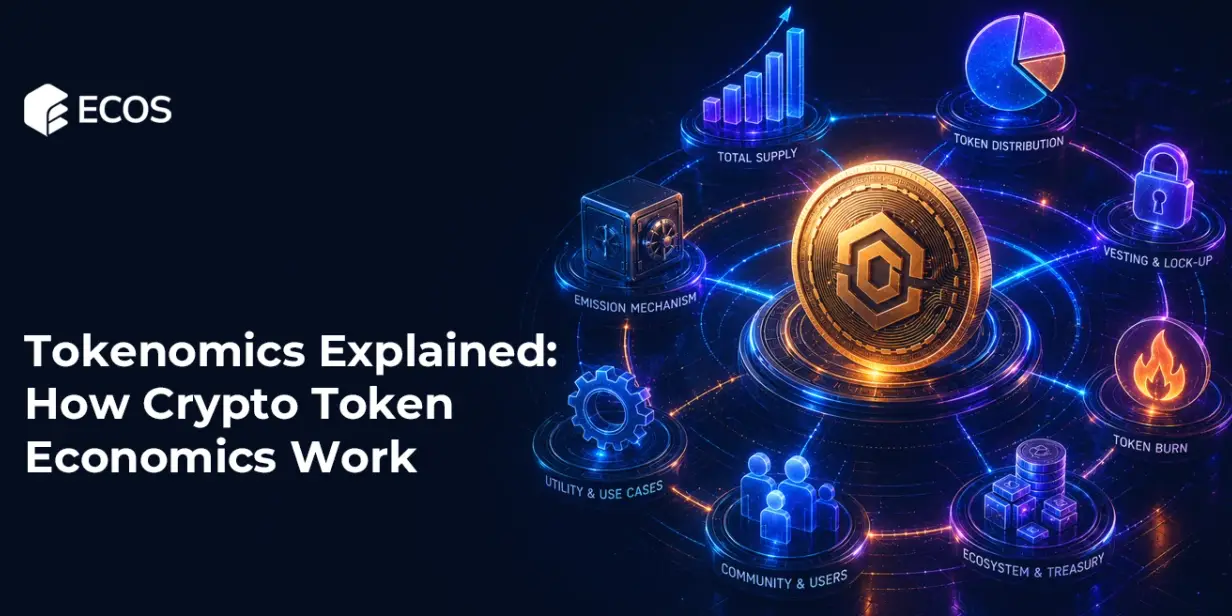
Tokenomics is the economic system of a specific cryptocurrency token. The term combines two words: token and economics. Tokenomics describes how a token is created, distributed, used, and destroyed within a project’s ecosystem.
A simple tokenomics definition: the rules that determine a token’s supply, its utility, and the incentives for all participants in the ecosystem. Good tokenomics aligns the interests of the team, investors, and users so that the project’s long-term growth benefits everyone.
Tokenomics differs from ordinary currency economics because its rules are written into smart contracts. This makes it transparent and verifiable: anyone can check the code and confirm that the conditions match what was stated.
Why study tokenomics? Because it determines a project’s long-term viability just as a business model determines a company’s viability. A beautiful website and bold promises mean nothing if the project’s tokenomics are structured so that early investors sell everything on day one of listing, leaving users with nothing.
Core Components of Tokenomics
Total Supply
Total supply is the maximum number of tokens that will ever exist. For Bitcoin this is 21 million BTC — a hard cap built into the protocol. Ethereum has no fixed supply: new ETH is continuously created through staking, though the EIP-1559 fee burning mechanism partially offsets issuance.
A capped supply creates deflationary pressure as demand grows. An uncapped supply can work just as well if issuance is balanced by token utility.
Circulating Supply
Circulating supply is the number of tokens actually in active circulation. This figure matters more than total supply because market capitalization is calculated from it: circulating supply × price = market cap.
Tokens can be temporarily removed from circulation through lock-up mechanisms — freeze periods during which team members or investors cannot sell their allocations. This is standard practice to protect the market from a sudden surge in supply.
Token Distribution
Distribution shows who received how many tokens at project launch. A typical structure includes: team (10–20%), early investors (15–25%), public sale (10–30%), ecosystem fund and reserves (20–40%).
The higher the team and early investors’ share relative to the public offering, the greater the risk for retail buyers. If the team holds 40% with a one-year lock-up, the market will face massive sell pressure in twelve months.
Emission Mechanism
Emission describes how new tokens enter circulation. Some tokens are fully minted at launch (pre-minted). Others are distributed gradually — through mining, staking, or other reward mechanisms.
Emission speed directly affects token inflation. A project with a high staking reward rate (200% annually) looks attractive until you realize: new tokens dilute existing holders’ stakes faster than value grows.
Burning Mechanisms
Token burning is the permanent removal of tokens from circulation. Tokens sent to a burn address disappear forever. This reduces supply and, with constant demand, creates deflationary pressure on price.
Binance Coin (BNB) is the classic example. Binance burns a portion of BNB quarterly, tying burn volume to exchange profits. This creates a mechanical link between business growth and shrinking token supply.
Token Utility
Utility answers the question: “what is this token actually for?” A token without utility is just a number in a database. Utility takes many forms: paying transaction fees (ETH on the Ethereum network), governing the protocol (voting rights in a DAO), accessing services, earning a share of protocol revenue through staking.
The more real use cases a token has, the more durable its demand. Speculative demand (“everyone’s buying because the price is rising”) evaporates at the first bear market. Utility demand persists as long as the service works.
Types of Token Supply
Different approaches to supply reflect different monetary philosophies.
Deflationary model. A hard-capped supply, like Bitcoin’s. Each halving cuts the rate of new coin issuance in half. The absence of inflation makes the asset attractive as a store of value.
Inflationary model. Continuous issuance to fund network security (staking rewards) or ecosystem grants. Effective when utility growth outpaces inflation.
Elastic model. Supply adjusts to price: when the price rises above a target level, tokens are issued; when it falls, they are destroyed. This is how some algorithmic stablecoins work. The model is theoretically elegant but historically unstable — the Terra/Luna collapse in 2022 is clear evidence.
Fixed supply at launch. All tokens are created immediately at launch with no subsequent issuance. This eliminates inflationary risk but creates another problem: how to finance development after starting reserves are exhausted?

How Tokenomics Works in Crypto Projects
Tokenomics is designed before a project launches and encoded in smart contracts. But in practice it is a living system that the market constantly stress-tests.
A simplified example. A project launches a token with a total supply of 100 million. The team receives 15% with a 24-month lock-up. Early round investors receive 20% with a 12-month lock-up. Public sale takes 10%. The rest is distributed gradually through ecosystem grants, staking, and Treasury.
In the first year, roughly 10 million tokens from the public sale are in circulation plus some staking rewards. At month 12, investors enter the market with 20 million tokens — more than double the current circulating supply. If the product has not demonstrated sustained user base growth by that point, the price collapses.
This is exactly what happened with many 2021–2022 projects. Investors took profits when lock-ups expired, the market could not absorb the sell volume, and prices dropped 80–90%.
Tokenomics Examples
Bitcoin: Deflationary Absolute
Bitcoin is the benchmark for minimalist tokenomics. 21 million BTC, predictable halvings every 210,000 blocks, no team or investor funds. All supply goes to miners as reward for network security.
The simplicity of Bitcoin’s tokenomics is one of the reasons for its reliability. No team can change the rules. No reserves can be secretly sold. Except perhaps Satoshi Nakamoto’s bitcoins.
Ethereum: Adaptive Model
Ethereum combines moderate inflation from staking rewards with the deflationary mechanism of base fee burning (EIP-1559). During periods of high network activity, Ethereum becomes net deflationary: more ETH is burned than created. During quiet periods — net inflationary.
This is a more complex system than Bitcoin’s, but logically consistent: network security is funded by moderate inflation, while the economic burden on holders is reduced through burning.
BNB: Token with Real Utility
Binance Coin was initially created as Binance’s utility token — at first only for trading fee discounts. Over time the scope expanded: gas on BNB Chain, paying for services, participating in IEOs. Regular burns tie supply to ecosystem activity.
BNB demonstrates how utility demand supports price regardless of the broader market mood.
Why Good Tokenomics Matters
Tokenomics determines whether a project survives its first bear market.
Investors look for answers to several questions. Does the token have real utility, or is demand purely speculative? What is the unlock schedule for team and investor tokens? Under what conditions will large supply volumes hit the market?
Good tokenomics aligns interests. The team receives tokens with long lock-ups — this forces thinking about long-term project growth rather than quick profit. Users receive incentives to use the protocol. Holders receive a share of the ecosystem’s growth benefits.
Bad tokenomics is aligned only on paper. In practice, insiders sell at the first opportunity, users lose the incentive to participate, and the token loses value.
Red Flags in Bad Tokenomics
Excessive insider share. If the team and early investors hold 50%+ of total supply, the market is essentially hostage to their selling decisions.
Short or absent lock-ups. A team without a lock-up can sell tokens on the day of public listing. This has happened.
Opaque distribution. If a project does not disclose who received how many tokens — that is a problem. Contract audits and a public tokenomics report should be the norm, not the exception.
Unrealistically high APY. Staking with 1000% annual yield is mathematically structured as: new participants subsidize earlier holders’ rewards. This is a pyramid in structure, even if the creators deny it.
No sink mechanisms. A sink removes tokens from circulation: burning, locked staking, paying for services. Without sinks, new issuance constantly dilutes holders.
How Investors Analyze Tokenomics
Professional tokenomics analysis begins with several documents and tools.
Whitepaper. The project’s main document should describe tokenomics in detail: total and circulating supply, emission mechanism, distribution, token utility.
Tokenomics dashboards. CoinGecko and CoinMarketCap show circulating supply and market cap. Token Unlocks and Vesting Schedule are specialized resources for monitoring token unlock schedules.
On-chain data. Etherscan, BscScan and equivalents let you verify real balances of major wallets, transaction history, and burn events.
Dilution multiplier. The ratio of fully diluted valuation (FDV — all tokens at current price) to market cap shows how many tokens have not yet entered the market. FDV/mcap = 10 means 90% of supply is still unlocked. When it arrives, sell pressure is inevitable.
Holder concentration. If 10 wallets hold 80% of supply, the token is vulnerable to coordinated selling.
Future of Tokenomics
The industry is moving toward more complex and adaptive models. Static tokenomics — rules written once in a whitepaper — is giving way to systems with dynamic parameters governed through DAO votes.
The vetoken model (vote-escrowed tokens), first implemented in Curve Finance, has become the industry standard for DeFi protocols. Holders lock tokens for a set period and receive enhanced voting rights and a share of fees. This aligns long-term participants’ interests and filters out short-term speculators.
Real-world assets (RWA) add a new dimension: when a token is backed by a real asset — a bond, real estate, a commodity — its tokenomics gains a connection to traditional financial metrics. This changes the analysis framework.
Regulation continues to shape tokenomics. As regulators distinguish between securities and utility tokens, projects are rethinking revenue distribution mechanisms. Models where token holders receive a share of protocol profits attract regulatory attention in many jurisdictions.
Tokenomics and Market Psychology
Well-designed tokenomics changes market participant behavior at the incentive level. Poor design creates rational incentives toward destructive behavior.
The classic example: a protocol with high APY and weak retention mechanisms. Participants arrive for yield, but at the slightest sign of falling rewards, they start exiting. Each exit reduces yield for those remaining, accelerating the next wave of exits. This is called the death spiral — not a metaphor, but a mathematically predictable outcome under certain incentive structures.
Curve Finance’s vetoken model was the answer to this problem. Holders lock CRV for anywhere from one week to four years and receive veCRV. The longer the lock, the more veCRV and the greater the share of fees and voting weight. The point: long-term participants get disproportionately large influence and returns. Short-term speculators find it unattractive. The system filters out unwanted behavior on its own.
Tokenomics and Governance
In decentralized protocols, a token often combines economic function with governance function. Holders vote on protocol parameter changes: fee rates, support for new assets, Treasury allocation.
This creates specific risks. With low governance decentralization, one large holder can push through any decision. This contradicts the stated decentralization. In Compound in 2023, one player accumulated enough COMP tokens to pass a controversial proposal independently. The community blocked the vote at the last moment.
Good tokenomics accounts for governance risks in advance: minimum quorum, a time delay between decision adoption and execution (timelock), and mechanisms protecting against voting attacks.
Tokenomics in DeFi
In decentralized finance, tokenomics is especially critical because users interact with the protocol directly, without intermediaries.
In liquidity protocols (AMM exchanges, lending protocols), tokenomics determines who receives fees: token holders, liquidity providers, the Treasury, or all at once. Uniswap has still not activated fee switch — the mechanism that directs part of fees to UNI holders. This is the subject of ongoing community debate: activation gives holders income, but may require regulatory classification of UNI as a security in some jurisdictions.
In staking protocols, tokenomics directly affects network security. Ethereum requires stakers to lock up significant capital. Too-low staking rewards reduce participation and weaken security. Too-high rewards create inflation that harms holders.
How to Read a Tokenomics Dashboard
Basic tokenomics analysis skills are accessible to any investor without a technical background.
Step 1. Check circulating supply and total supply on CoinGecko or CoinMarketCap. A large gap signals significant future token release.
Step 2. Find distribution information: who received tokens at launch and on what terms. This data should be in the whitepaper or on the official site.
Step 3. Check the unlock schedule on Token Unlocks or similar resources. Look for when the next large volume from investors or the team enters the market.
Step 4. Calculate FDV: total supply × current price. Compare to market cap. If FDV is 20x higher than mcap, most of the supply is still ahead.
Step 5. Study utility mechanisms and sinks. Does the token have real reasons for demand beyond price appreciation expectations?
Tokenomics in Gaming and Metaverses (GameFi)
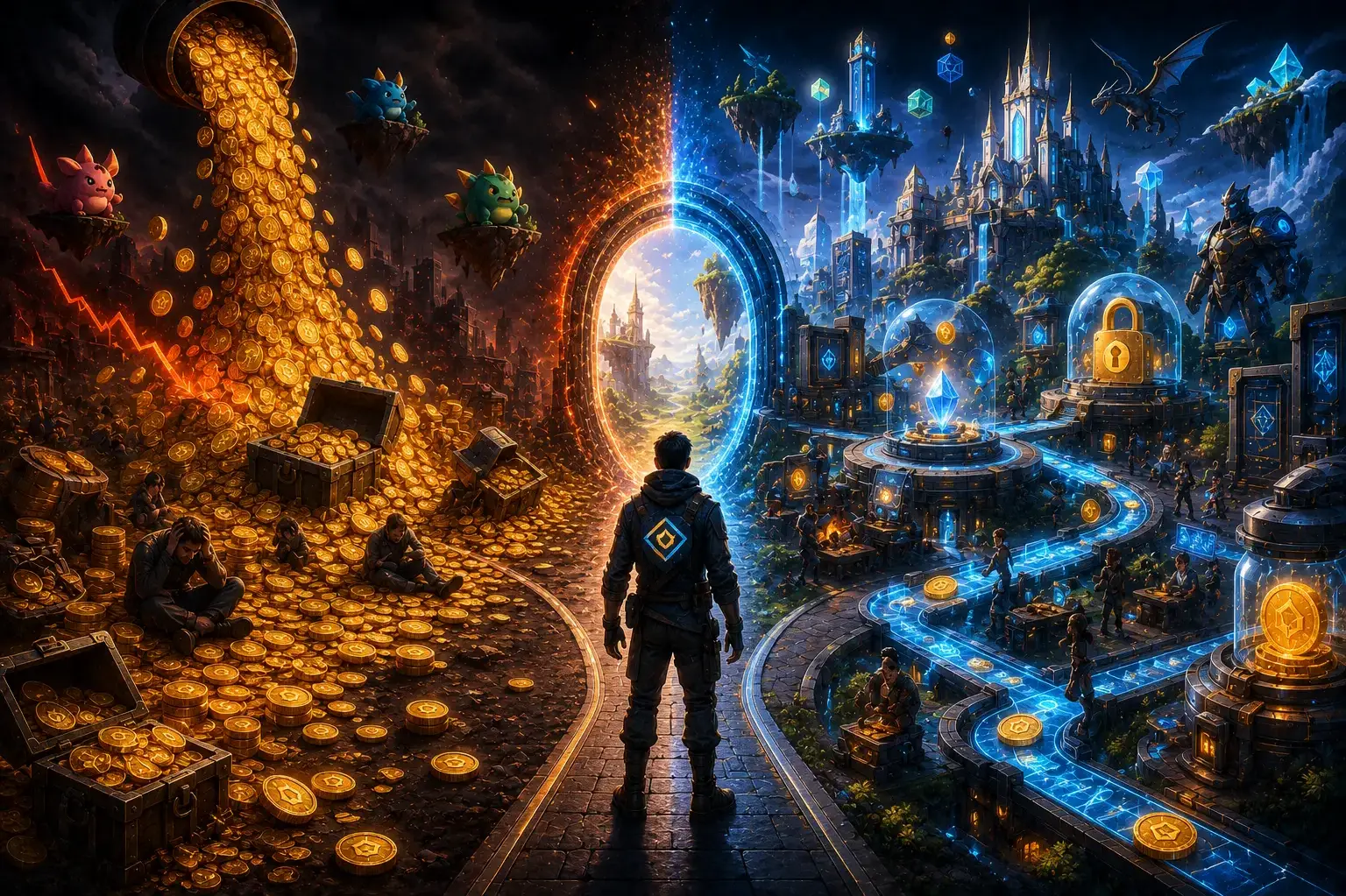
Play-to-earn games pushed tokenomics into a new dimension, colliding it with what traditional economics calls “reward inflation.”
In Axie Infinity in 2021, the SLP token that players received as reward was issued in enormous volumes. Demand could not keep up with supply. The price collapsed 99%. Players from developing countries who had counted on stable income lost it.
The lesson for the entire sector: gaming tokenomics must be designed no less carefully than the mechanics of any other reward, from mining to staking. If players earn tokens but do not spend them on something valuable within the ecosystem, excess supply is inevitable.
The best GameFi projects of 2023–2025 incorporated this lesson. They separated in-game currency from the governance token. The former is inflationary and used within the game. The latter is deflationary, with limited supply and real utility demand.
Key Takeaways
- Tokenomics is the economic system of a token: rules governing supply, distribution, utility, and destruction. It determines whether a project survives long-term.
- Core components: total and circulating supply, emission mechanism, unlock schedule, token utility, and burning (sink) mechanisms.
- Good tokenomics aligns interests: the team receives tokens with long lock-ups, users get incentives to participate, holders get a share of ecosystem growth benefits.
- Red flags: high insider share, short lock-ups, unrealistic APY, and no mechanisms for removing tokens from circulation.
- When analyzing: look at FDV/mcap ratio, unlock schedules, holder concentration, and real token utility.
- Tokenomics is evolving: vetoken models, real-world asset integration, and regulatory pressure are shaping the next generation of token economics.
Expert Insight
CoinMarketCap, in its educational section on tokenomics, states: “Tokenomics is central to investment decision-making in cryptocurrency projects. Understanding how tokens are created, distributed, and destroyed gives investors insight into a project’s long-term viability and growth potential.”
This remains true today. After the collapse of most ICO projects in 2017–2018 and the Terra/Luna crash in 2022, it became clear: a technically interesting product with poor tokenomics loses to a boring product with well-designed token economics. An investor who can read tokenomics sees half the picture before the market does.
Conclusion
Tokenomics is not magic and not a separate science. It is a set of economic principles applied to digital assets. Understanding these principles does not guarantee correct investment decisions, but it removes the layer of illusions that bad projects often hide behind.
More Questions
Tokenomics is the economic system of a cryptocurrency token: a set of rules governing its supply, distribution, utility, and destruction mechanisms. The term combines the words token and economics.
Good tokenomics aligns the long-term interests of the team, investors, and users. Poor tokenomics creates conditions where insiders sell tokens while retail holders absorb losses.
Study the whitepaper for token distribution and unlock schedule. Check the FDV/market cap ratio. Identify mechanisms for removing tokens from circulation. Assess real token utility.
FDV (Fully Diluted Valuation) is the total token supply multiplied by the current price. High FDV relative to market cap means a significant portion of supply has not yet entered the market.
A lock-up is a period during which holders (team, investors) cannot sell their tokens. It protects the market from a sudden supply surge immediately after listing.
Burning is the permanent removal of tokens from circulation by sending them to an address with no private key. It reduces supply and, with constant demand, creates deflationary pressure on price.
Published Articles
Crypto On-Ramps and Off-Ramps Explained: How Fiat and Crypto Move In and Out
Entering the world of digital assets often feels like trying to cross...
 Popular
Bitcoin Pizza Guy: The Story Behind the First Real Bitcoin Purchase
Introduction The history of Bitcoin is full of dramatic ups and downs,...
Crypto Basics Explained: A Beginner’s Guide to Cryptocurrency and Trading
Introduction The world of finance is changing right before our eyes. Just...
 Popular
Uniswap Explained: What It Is, How It Works, and How to Use the UNI DEX
Introduction Decentralization and decentralized platforms that have emerged in recent years have...
 Popular
Bitcoin Lightning Network Explained: What It Is and How Bitcoin Lightning Works
Introduction In the world of cryptocurrency, transaction speed and costs have always...
How Bitcoin ATMs Work: A Complete Guide to Using Crypto ATMs
Introduction Millions of people around the world use cryptocurrencies today – at...