
What Is a Fiat Wallet? Meaning, How It Works, and Safety Explained
Introduction
A crypto exchange is not just a place to trade BTC and ETH. Before buying their first coin, most users encounter something more mundane: they need to put regular money in. This is where a fiat wallet comes into play.
This term feels intuitive but rarely gets explained clearly. What does having such a balance mean in practice? How does this option differ from a regular bank account and from a crypto wallet? Is holding traditional currency on an exchange safe? Let us work through this in order.
What Is a Fiat Wallet?
Fiat Wallet Meaning
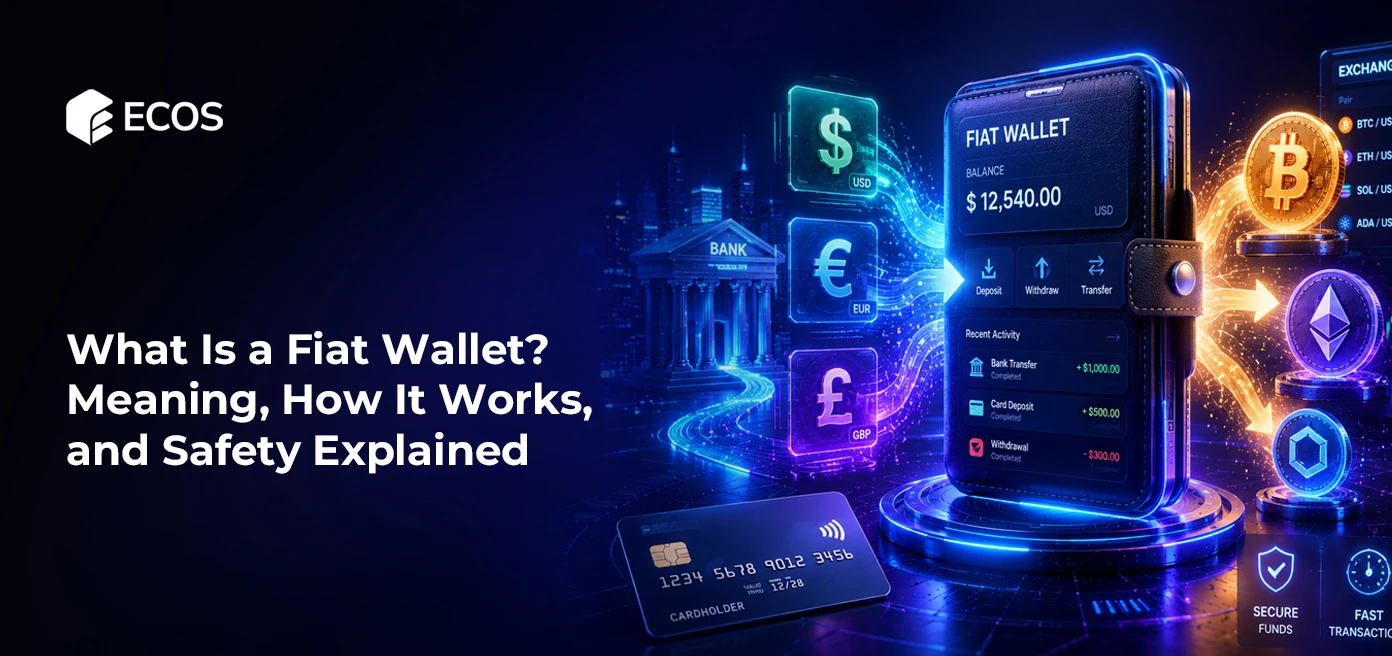
A fiat wallet is a digital account on a cryptocurrency platform or fintech service designed to hold regular (fiat) money: dollars, euros, pounds, and other national currencies. What is a fiat wallet in the context of a crypto platform? It is an intermediate storage between your bank and the crypto market. You deposit money, it sits in the fiat wallet, and from there you buy cryptocurrency — without needing to initiate a bank transfer every time.
The word “fiat” comes from Latin, meaning “let it be done,” and refers to currency whose value is established by government decree rather than by a peg to any physical asset.
Definition in Crypto Platforms
On most major exchanges — Coinbase, Kraken, Binance — the fiat wallet appears as a separate balance in the interface. It shows how much “real” money you have on the platform, ready to use. It is not exactly a bank account, and not a crypto wallet — it is a hybrid instrument living at the intersection of two financial worlds.
What is fiat wallet in crypto more specifically: a software mechanism that allows the exchange to hold client funds in fiat, process deposits and withdrawals, and execute conversion to cryptocurrency instantly — at the press of a button.
Difference From Crypto Wallets
The fundamental difference between a fiat wallet and a crypto wallet lies in the nature of the stored asset and the storage mechanism. A crypto wallet stores private keys that provide access to a blockchain address. A fiat wallet stores a platform obligation — a record in its database that a certain amount in a specific currency belongs to you.
This means: in a crypto wallet you control funds directly. In a fiat wallet — through the platform intermediary. Different degrees of sovereignty over your money, with different risks and conveniences.

What Is a Fiat Account?
Bank Account vs Fiat Wallet
A fiat account on a crypto platform and a bank account perform similar functions but work differently. A bank account is insured by the government (in the US — up to $250,000 through FDIC; in the EU — up to €100,000 through DGS). A fiat wallet on an exchange is not, unless the platform explicitly states otherwise.
A bank operates with your money under strict regulation: reserve requirements, mandatory audits, deposit insurance. An exchange holds client fiat funds according to its own policies and license requirements. In regulated jurisdictions this involves segregating client funds from operational funds — but the level of protection is still not identical to banking.
Role in Exchanges
The fiat wallet solves a specific problem: speed. A bank transfer can take 1–3 business days. An internal balance in a fiat wallet allows buying cryptocurrency instantly — the money is already on the platform, the transaction happens inside the system.
For active traders this is critical: reacting to a market move in seconds, not waiting until tomorrow’s bank transfer confirmation. For ordinary users — simple convenience: fund once, buy when needed.
Supported Currencies (USD, EUR, etc.)
Most major platforms support USD, EUR, and GBP as primary fiat currencies. The extended list depends on the exchange’s jurisdiction and banking partners. Binance supports dozens of fiat currencies through various payment methods. Coinbase focuses primarily on USD and EUR. Kraken is a strong European platform with solid coverage for euros, pounds, and several other currencies.
How Fiat Wallets Work
Depositing Money
You can fund a fiat wallet in several ways depending on the platform and jurisdiction. Bank transfer (SEPA in Europe, ACH or Wire in the US) — generally free or minimal commission, but takes 1–5 business days. Debit or credit card — instant, but with a 1–4% fee. PayPal and other e-wallets — fast, fees vary.
Once credited, the funds appear in the fiat wallet interface as a balance in the corresponding currency. From that point you can trade without additional delays.
Converting Fiat to Crypto
This is the core function of the fiat wallet in the crypto ecosystem. You choose a cryptocurrency, specify an amount in fiat or number of coins — the exchange calculates the rate based on current market price and spread, deducts the amount from the fiat balance, and credits the cryptocurrency to the crypto wallet.
The process takes seconds. No additional banking operations — the transaction is entirely internal until you decide to withdraw cryptocurrency to the blockchain.
Withdrawing Funds
You can withdraw money from a fiat wallet back to a bank or through other available methods. Return transfer speed depends on the method: SEPA — 1–2 business days, Wire — same day or next day, card — instant or within a few days depending on the receiving bank.
Most platforms set withdrawal limits for unverified accounts. After completing KYC, limits generally increase significantly.
Fiat Wallet in Crypto Exchanges
All major centralized exchanges (CEX) implement fiat wallets as part of core functionality. The differences are in the details.
On Coinbase, the fiat wallet is central to the user experience: simple interface, card and bank transfer support, PayPal integration. Kraken emphasizes professional tools: supports more deposit methods in Europe, including FPS and CHAPS for UK users. Binance offers a broad selection of local payment methods depending on the user’s country.
Platforms like Revolut or Cash App combine traditional financial service with crypto features: their fiat wallet is literally a bank account with an option to buy crypto.
Fiat Wallet vs Crypto Wallet
Comparing these two tools works best across several parameters.
Control over funds. A crypto wallet, especially a non-custodial one, gives full sovereignty: you control the private keys and no one can freeze your assets. A fiat wallet on an exchange is always a custodial model: the exchange holds your money, and if the platform has problems, access may be restricted.
Volatility. A fiat wallet holds stable money — $1,000 tomorrow will still be $1,000. A crypto wallet is a different story.
Regulatory status. Fiat wallets on licensed platforms operate within a legal framework with KYC/AML requirements. Non-custodial crypto wallets exist outside direct regulatory oversight.
Advantages of Fiat Wallets
For most users, the main advantage is ease of market entry. A fiat wallet removes technical complexity: no need to understand blockchain addresses, gas fees, and seed phrases to buy your first bitcoin. The process closely resembles funding a regular payment service.
Trading speed is the second key benefit. A pre-loaded fiat balance lets you react to market movements instantly. This matters especially in volatile conditions, where a few-hour delay can shift the purchase price by several percent.
Wide accessibility. Major exchanges support deposits via cards, bank transfers, PayPal, and other familiar methods. For a beginning investor, this significantly lowers the barrier to entry.
A single interface. Holding both fiat and crypto in one place is convenient for portfolio management and quick conversion in either direction.
Fiat Wallet and Regulation
The regulatory status of fiat wallets continues to develop — and this is one of the key factors to consider when choosing a platform.
In the European Union, MiCA (Markets in Crypto-Assets Regulation) established uniform requirements for crypto platforms, including mandatory segregation of client fiat funds from the company’s operational balance. Platforms holding a CASP (Crypto-Asset Service Provider) license must comply with these standards, which significantly reduces the risk of client fund loss during financial difficulties.
In the US, the situation is less uniform. There is no federal law specifically regulating crypto exchanges yet, though legislation is being debated. Some exchanges operate as MSBs (Money Services Businesses) under FinCEN requirements. Coinbase as a public company (NYSE: COIN) falls under SEC regulation and state regulators.
The practical takeaway for users: before registering, check which jurisdiction the platform is incorporated in and what licenses it holds. An exchange with FCA, MAS, or BaFin licenses represents a fundamentally different reliability level than a platform with no clear regulatory status.
Risks and Limitations
Counterparty risk is the primary risk of a fiat wallet. Your money is held on the platform, not under your direct control. If the exchange goes bankrupt (as FTX did in 2022), withdrawal may be blocked for an extended period or never happen.
No insurance. Unlike a bank deposit, a fiat balance on an exchange is not insured by government schemes in most jurisdictions. Some platforms offer proprietary insurance against hacks — but not against bankruptcy.
Regulatory risks. An exchange can suspend operations in your country, freeze accounts, or restrict withdrawals for regulatory reasons without warning.
Fees. Currency conversion, withdrawals, and card top-ups can carry hidden costs. Study the platform’s fee schedule before making your first deposit.
Is a Fiat Wallet Safe?
Safety of a fiat wallet depends on two factors: platform reliability and user behavior.
From the platform side: use only licensed exchanges with transparent client fund policies. Signs of a reliable platform: public Proof-of-Reserves, regulatory license in a reputable jurisdiction (FCA, MAS, FinCEN), hack insurance, segregated client and operational fund storage.
From the user side: enable two-factor authentication, use a unique password, do not keep more in your fiat wallet than you plan to use in the near term. Long-term savings belong in a bank or under personal control.

How to Choose a Platform With a Fiat Wallet
Choosing a platform is one of the most important decisions for a new user. Fiat wallets exist on most major exchanges, but the terms differ significantly.
Key things to check: support for your national currency; support for your preferred deposit methods — card, SEPA, PayPal; fees for deposit, conversion, and withdrawal; regulatory status and licenses held; KYC verification requirements and limits; insurance coverage.
European users will find SEPA transfers (generally free within the EU) and euro wallet availability especially relevant. In the United States, ACH support and compliance with state laws become the top priorities. Meanwhile, people from other regions should look closely at the availability of local payment methods, which varies considerably between exchanges.
Equally important: how easy it is to withdraw money back out. Depositing fiat is straightforward almost everywhere; withdrawals sometimes involve delays, limits, and additional requirements. Check this before depositing.
When to Use a Fiat Wallet
A fiat wallet is the right tool in specific situations.
If you are starting trading, you might want to convert money into cryptocurrency quickly, avoiding bank transfer delays on every purchase. As an active trader, holding positions in fiat between trades is essential without constantly withdrawing to a bank account. For regular purchases, keeping a small balance “on hand” is highly convenient.
A fiat wallet is not suited for long-term storage of large sums — that is a role for a bank or another insured instrument. And it does not replace a crypto wallet if full platform independence is important to you.
Key Takeaways
- A fiat wallet is a digital balance on a crypto platform for holding regular money (USD, EUR, etc.), serving as a bridge between the banking system and the crypto market.
- Unlike a bank account, a fiat wallet is not covered by government insurance schemes and carries the platform’s counterparty risk.
- The key advantage is speed: money is already on the platform, and conversion to cryptocurrency happens instantly without waiting for a bank transfer.
- Fiat wallet vs crypto wallet: fiat stores stable currency in a custodial model; crypto wallet stores digital assets with the option of direct control through private keys.
- The safety of a fiat wallet depends on platform reliability: license, Proof-of-Reserves, insurance, segregated fund storage.
- Optimal use is for active trading and quick conversions; long-term savings are better held in a bank or under personal control.
Expert Insight
Coinbase’s official user documentation describes the fiat wallet as a tool allowing users to hold local currency directly on the platform for faster trading. The company specifically notes that funds in the USD Wallet are held at FDIC-insured partner banks, up to $250,000.
This detail is worth verifying with every platform individually: fiat balance insurance is not a universal practice but a competitive differentiator. Most exchanges offer no such protection. Before funding a fiat wallet on any platform, clarify where the funds are actually held and what protection scheme applies.
Conclusion
A fiat wallet is a convenient, practical tool for entering the crypto market. It solves a real problem: eliminating the delay between deciding to buy cryptocurrency and making the purchase. But it is a custodial service, not a bank account — with the corresponding risk profile.
More Questions
A fiat wallet is a digital account on a crypto platform for holding regular money: dollars, euros, pounds. It enables quick conversion to cryptocurrency without bank transfer delays.
A fiat wallet holds regular money in a custodial model. A crypto wallet holds digital assets and can be non-custodial — with full control through private keys.
It depends on the platform. On licensed exchanges with segregated fund storage — relatively safe. But not government-insured like a bank deposit. Do not hold large amounts there long-term.
An internal balance in fiat currency, separate from your crypto balance. Allows holding money on the platform and transacting without bank transfers at each trade.
Fiat currency is not “bought” — it is deposited onto the platform via bank transfer, card, or e-wallet. Once credited it appears in the fiat wallet and is available for buying cryptocurrency.
Published Articles

Crypto On-Ramps and Off-Ramps Explained: How Fiat and Crypto Move In and Out
Entering the world of digital assets often feels like trying to cross...
 Popular
Bitcoin Pizza Guy: The Story Behind the First Real Bitcoin Purchase
Introduction The history of Bitcoin is full of dramatic ups and downs,...

Crypto Basics Explained: A Beginner’s Guide to Cryptocurrency and Trading
Introduction The world of finance is changing right before our eyes. Just...
 Popular
Uniswap Explained: What It Is, How It Works, and How to Use the UNI DEX
Introduction Decentralization and decentralized platforms that have emerged in recent years have...
 Popular
Bitcoin Lightning Network Explained: What It Is and How Bitcoin Lightning Works
Introduction In the world of cryptocurrency, transaction speed and costs have always...
How Bitcoin ATMs Work: A Complete Guide to Using Crypto ATMs
Introduction Millions of people around the world use cryptocurrencies today – at...