
Crypto Mining Containers: How Modular Solutions Power Bitcoin Mining Operations
Why Mining Operators Use Containers
A new mining site often starts with raw power and little else. While a substation, gravel pad, and internet connection might be in place, building a permanent structure for hundreds of ASICs can easily outlast the profitable purchasing window for the hardware. This is where crypto mining containers come in, allowing operators to pre-assemble modular, repeatable equipment blocks off-site and quickly deploy them the moment the electrical infrastructure is ready.
The appeal is easy to understand. One unit goes online, the team learns how it behaves through a hot afternoon and a dusty week, and the next unit follows. Expansion can pause if the power deal changes. That flexibility has limits, though. A badly designed container simply concentrates the same electrical and cooling problems into a tighter space.
What Is a Crypto Mining Container
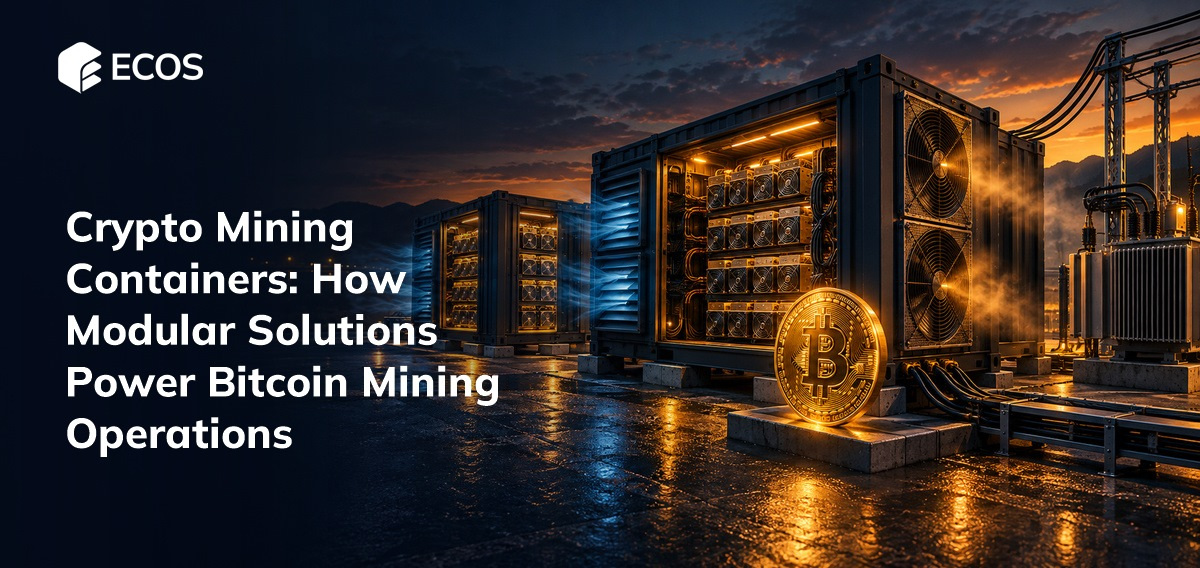
Crypto mining containers are enclosed mining rooms that can travel by truck. Some begin life as freight containers; others are built from a new steel frame. Racks line the interior, with power and Ethernet delivered to each miner. Fans or a liquid loop carry heat outside. Sensors report what is happening when nobody is standing beside the unit.
A vendor may advertise capacity as a miner count. That number can mislead. Two ASIC models may occupy the same shelf while drawing very different power, and every kilowatt entering the miner eventually appears as heat. If 200 machines draw 3.5 kW each, the container has roughly 700 kW of heat to remove. Rack space alone says almost nothing about whether it can do that safely.
How Shipping Containers Are Converted for Mining
The first cuts in the shell usually create a large intake wall and an exhaust opening. After that, the conversion becomes less visible. Builders reinforce mounting points, seal cable entries against rain, and plan a route for technicians carrying a heavy miner through a narrow aisle. A floor that looks fine when empty may flex once racks, switchgear, and several tonnes of equipment are inside.
Fans, electrical panels, network gear, and fire sensors are fitted before the unit leaves the workshop. The awkward details matter here. A sharp metal edge can damage a power cable after months of vibration. An exhaust hood can keep out rain and still choke airflow. These flaws tend to appear only when the container is loaded and the fans are pulling against real resistance.
Purpose Built Units and Retrofitted Shells
Used freight containers are widely available and easy to transport. Their dimensions are fixed, however, and the corrugated walls were never designed around miner racks. Rust around the lower rails or a distorted door frame can complicate sealing. A careful buyer inspects the actual shell instead of relying on a generic drawing.
A purpose-built module costs more at the fabrication stage in many cases. The designer gains room for a wider service aisle, a separate electrical bay, or a better intake geometry. Whether that extra room earns its cost depends on how often staff will work inside and how long the site is expected to operate.
How Bitcoin Mining Containers Work
The first live rack tells the crew more than an empty-container inspection. Current appears at the panel, the miners find their pool, and warm air reaches the exhaust within minutes. If those readings look normal, another rack is started. This continues until the container reaches its planned load.
Conditions rarely stay fixed for long. Dust collects on a filter and a change in wind pushes against the exhaust. After a short voltage dip, several miners may restart together. Each event is small. Combined, they can raise inlet temperature or create rejected work before anyone sees a machine go fully offline.
Almost all the electrical energy consumed by an ASIC leaves as heat. Air cooling carries it through the miners and out of the hot side. An immersion system takes the same heat into fluid and sends it to an outdoor exchanger. In both cases, placement matters. Heat released beside a nearby intake can circle back into the container the system is trying to cool.
ASIC Miner Installation
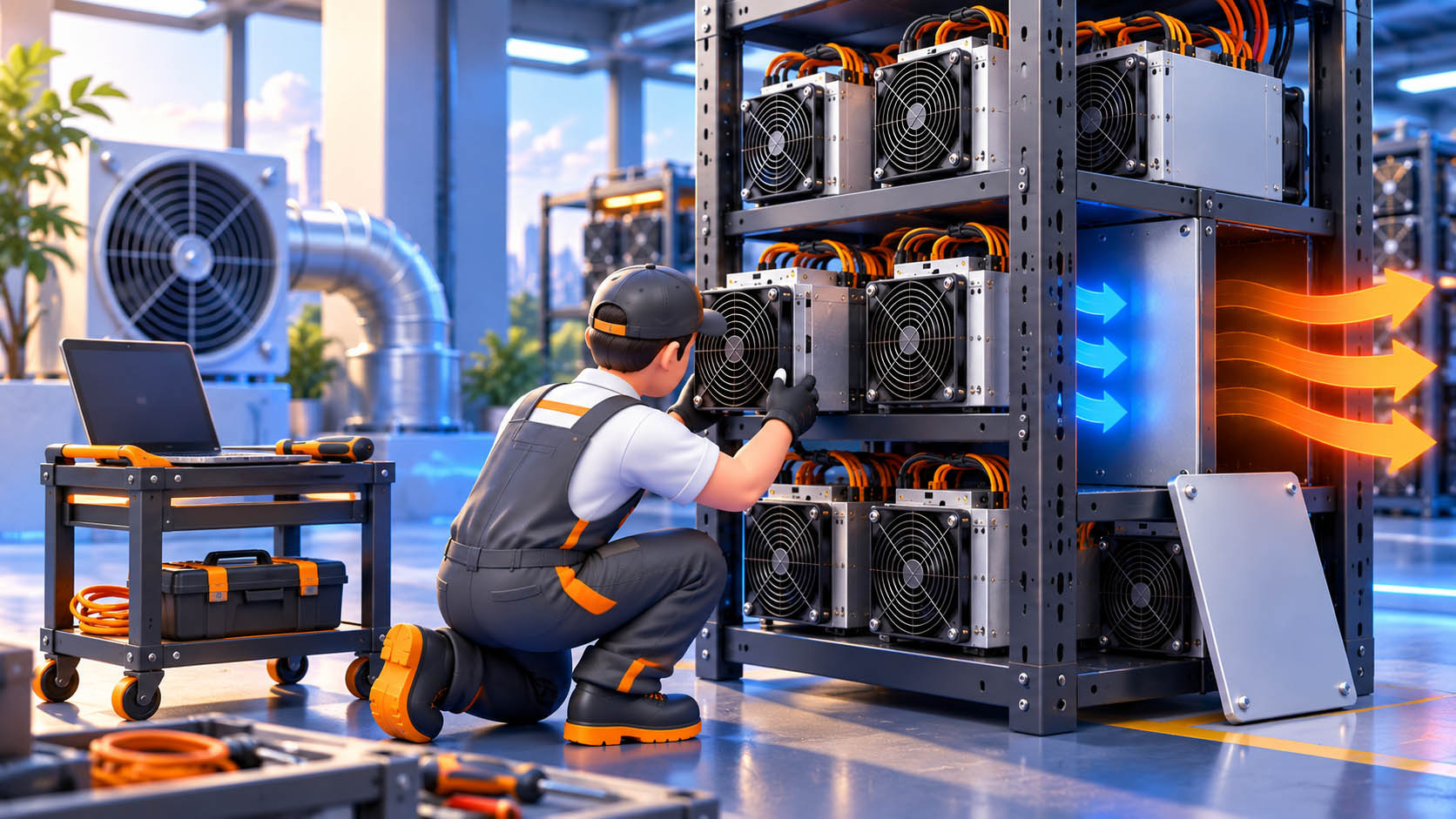
A serial number is easiest to record while the miner is still in the technician's hands. Linking it to a rack position at that moment saves an unpleasant search later. An alert can point to B-17, for example, and the person entering the container knows which machine to pull.
Crews usually start with one rack. They look at phase current and inlet temperature, then walk the hot side to check for a reversed fan or an unexpected dead spot. Only after that rack settles down does the next group come online. A full-fleet start makes a weak breaker setting or misplaced air barrier much harder to trace.
Rack Layout and Service Access
Rack density looks attractive until a power supply has to come out. If the technician must unplug two healthy miners to reach it, a minor repair causes avoidable downtime. Hand clearance and room for the cable bend are worth checking with an actual miner before the rack design is repeated.
An empty slot causes a different nuisance. Hot air slips through the opening and returns to the intake side, often warming the two machines beside it. A blanking panel closes the path. The fix is ordinary sheet metal, which is why it is easy to overlook during a complicated build.
Power Distribution
Electrical faults often begin quietly. A terminal loosens, its resistance rises, and the connection starts running hotter than the cable around it. The miner may continue hashing while the insulation darkens. Thermal checks during commissioning and scheduled retorquing can catch that kind of problem before it damages the panel.
Power reaches a miner through several protective devices. Their settings have to work together. A failed power supply should trip its rack circuit; it should not shut down every machine in the container. Selective protection takes more engineering than installing breakers with convenient ratings, and the difference becomes obvious during the first fault.
Rack meters are useful when the software numbers stop making sense. Suppose one row reports normal hashrate while its measured draw has climbed. The discrepancy may lead to a bad power supply or an incorrect performance profile. It gives the electrician somewhere specific to begin instead of testing every circuit.
Phase Balance and Power Quality
A clamp-meter reading can expose an uneven rack plan immediately. One phase may already be close to its limit while the others have comfortable headroom. The imbalance can return after a hardware refresh, since replacement models rarely draw exactly what the old machines did.
Power supplies also distort the current waveform, and local voltage can move when other industrial equipment switches nearby. These effects are measured at the site. Once the readings are known, the electrical engineer can set protection and decide whether the installation needs additional correction equipment.
Restoring power after an outage deserves its own sequence. Starting hundreds of supplies together may pull the voltage down far enough to cause another trip. Bringing racks back in groups takes a few extra minutes and usually avoids a second visit to the switchgear.
Cooling and Ventilation Systems
A fan rating is measured under stated test conditions. Once the fan is mounted behind louvers, filters, and a wall of miners, it delivers less air. This is where otherwise credible container designs sometimes fail: the arithmetic uses the label on the fan and ignores everything resisting the flow.
A full-load test should record temperatures at several points, not only near the control cabinet. The hottest inlet is often at an edge or in a rack farthest from the fresh-air opening. A single average can hide it. Operators also need to know how quickly temperatures rise after a fan stops, because that interval determines the shutdown response.
Air Cooling
Air cooling keeps the original ASIC chassis and is familiar to most repair teams. Filters are the recurring chore. In a dry location, a clean filter can collect a visible layer of dust surprisingly quickly, restricting airflow long before it looks completely blocked.
Cold weather creates a different problem. Pulling very cold outdoor air onto warm boards can produce sharp temperature gradients, while a shutdown and restart may introduce condensation. Intake mixing or controlled fan speed helps keep the inlet within a range the equipment can tolerate.
Immersion Cooling
Immersion tanks hold the hash boards in dielectric fluid after their stock fans have been removed. A pump carries the warmed fluid to a heat exchanger. The familiar roar of hundreds of small fans disappears, and chip temperatures tend to move less sharply as outdoor air changes.
The trade brings different repair jobs. Pumps wear, hose fittings seep, and the outdoor cooler collects debris. A technician can wipe up a small leak; a stopped circulation pump is urgent because every miner in the tank shares it. Flow alarms and an automatic shutdown need to be proven with a real test.
Before conversion, the owner should ask the repair provider how it treats boards that have been immersed. Policies vary. Recording the fluid, cleaning method, and date of conversion prevents an argument over equipment history after a board fails.
Network Connectivity
Mining traffic is light enough to hide a poor connection. A link can look fine during a quick speed test and still drop for a few seconds throughout the day. Those short gaps leave stale shares behind, although every ASIC continues to show power and spinning fans.
The switches are better kept away from the hottest exhaust and where a technician can reach them without climbing over miners. Pool credentials and worker names need a current backup. Rebuilding that configuration by hand after a controller failure is tedious, and transcription errors can send hashrate to the wrong account.
For a distant site, a second internet route buys time. It may be a modest cellular or radio link with no capacity for office use. That is enough if it preserves pool sessions and lets the operator see why the primary circuit went dark.
Monitoring and Security Systems
The most troublesome miner is often green on the dashboard. It reboots, returns before the offline alarm expires, and repeats the cycle a few hours later. Pool-side hashrate and restart history reveal the loss. A simple online count does not.
Alerts need an owner and a response. A high-temperature message at 3 a.m. is useful only if someone knows whether to lower power, shut down a rack, or drive to the site. Too many low-priority notifications train staff to ignore the channel, including the one alarm that matters.
Physical security works in layers. Site access records and cameras help deter theft, while container sensors show whether a door opened outside a maintenance window. Emergency stops and temperature protection remain local. They must still work when the internet connection or monitoring server is down.
Continuous Mining Operations
Filters, fan bearings, cable terminals, and power supplies wear on different schedules. A calendar gives the crew a starting point, but inspection findings should adjust it. A filter interval that works in winter may be far too long during a dry summer.
Position-level records make recurring faults visible. If power supplies keep failing in the same rack, the rack deserves attention. The cause may be heat recirculation or a poor connection upstream. Replacing each failed supply without examining the pattern treats the symptom and leaves the fault in place.
Remote Operations and On Site Work
Remote tools handle routine actions well. Staff can change pool settings, reduce power, restart a miner, or flag a unit for service before the next site visit. They cannot clean an intake, tighten a terminal, or replace a fan.
This matters most at isolated sites. A storm may turn a two-hour service visit into a full day, and a missing spare can add another trip. Staffing and inventory estimates should use that real travel time rather than the distance shown on a map.
Container Mining and Traditional Facilities
A permanent hall gives engineers freedom to set aisle width, ceiling height, and electrical-room size around the operation. Technicians have more room, and later changes are easier to accommodate. The owner pays for that flexibility before the first ASIC starts hashing.
Crypto mining containers commit capacity in smaller pieces. They can arrive while work continues on another part of the site, which is valuable when deployment time affects revenue. Moving one later is possible, although the crane, transport, disconnect, and new utility work make relocation a project of its own.
At a very large site, modularity can become duplication. Each container may bring another panel, network cabinet, controller, and set of fans. A central building starts to look more attractive once the cost of maintaining dozens of separate equipment rooms overtakes the benefit of adding them one by one.
Advantages of Bitcoin Mining Containers
The clearest advantage is that site work and module assembly can happen at the same time. When both are finished, connection and commissioning replace months of interior construction. Operators can also repeat a layout that their technicians already know.
Add capacity one module at a time as power becomes available.
Test wiring and airflow in the workshop before shipment.
Use the same spare parts and service procedure across matching units.
Place computing load near an energy source that cannot support a large permanent building.
The last point is often overstated. A remote energy source still needs road access, communications, security, and someone able to repair the equipment. Cheap electricity loses its advantage quickly when the mine spends days waiting for basic service.
Disadvantages and Operational Risks
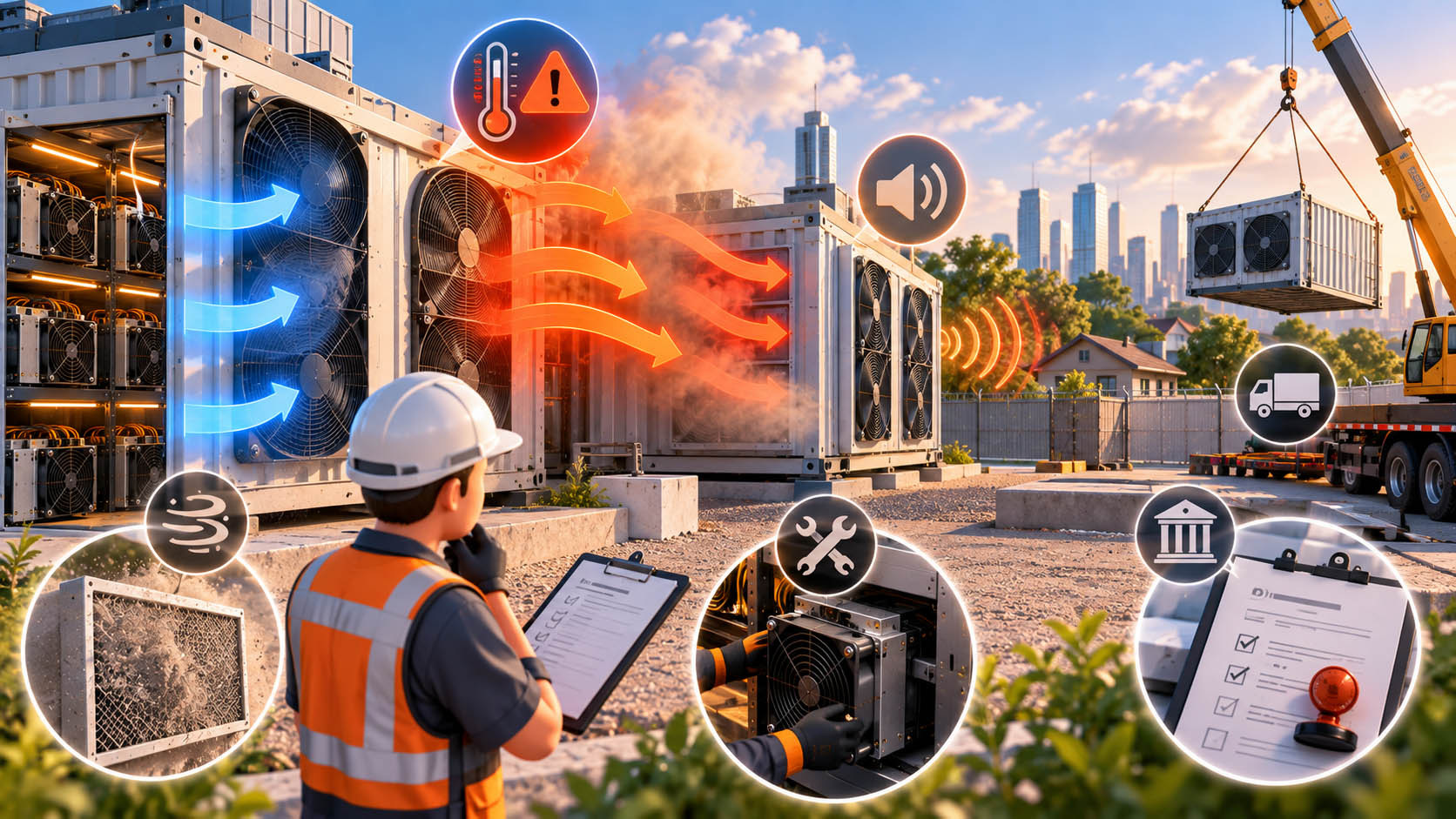
Space between containers is part of the cooling system. Put an intake too close to a neighboring exhaust and both units may pass their own factory test yet overheat on site. A failed fan bank spreads the effect quickly because the racks share such a small air volume.
Noise can also escape in unexpected directions. Steel panels reflect the fan tone, and a quiet night makes it audible farther away than a daytime visit suggests. Measuring at the property boundary before the layout is fixed leaves room to rotate a unit or add attenuation.
Check whether a technician can remove a miner safely with the opposite rack still running.
Estimate filter use from the actual site, especially during its driest season.
Price a possible move with crane work, electrical disconnection, transport, and recommissioning included.
Confirm how local officials classify the installation before ordering the module.
Portable is a description of the shell, not a permit category. Officials may look at the electrical connection, planned time on site, noise, fuel storage, and total load. An early site conversation is much cheaper than moving finished equipment after an inspection.
Economics and Payback
The container quote is the easiest number to obtain and one of the least useful on its own. A working site also needs a transformer, switchgear, foundations, cabling, internet, fencing, and a way to unload the module. Engineering and permits arrive before revenue; repairs and filters continue after it.
On the revenue side, hashrate is only the starting input. Difficulty changes, pool results vary, machines go offline, and Bitcoin price moves. A sensible model keeps those assumptions visible by month. It also includes the moment when an older miner consumes enough power that running it no longer makes sense.
Payback should cover the system that actually produces the hashrate. A bargain enclosure with weak ventilation can cost more through throttling and failures than a better unit cost upfront. Comparing cost per usable megawatt is more informative when the calculation includes the power infrastructure and the load the cooling system can sustain on the hottest expected day.
How to Choose a Bitcoin Mining Container
Begin with a miner list and a site description. Send the vendor the exact models and power modes, along with the utility voltage and local temperature range. Photos of dust, snow, or salt exposure are more useful than describing the climate as harsh.
Then ask for the engineering behind the offer. Electrical drawings should show protection and cable sizes. The airflow calculation should state ambient temperature and pressure losses. If the vendor has tested a loaded unit, ask where temperatures were measured and for how long.
Operating references help when the comparison is fair. A lightly loaded unit in a cool climate says little about a full container headed to a hot, dusty site. Speak with a customer whose equipment and weather resemble the proposed project.
Questions for a Vendor
How much continuous load was the container carrying during its hottest completed test?
Were those test machines the same models planned for this project?
Can the vendor provide readings from the hottest and coolest rack positions?
Which replacement fan or controller has the longest lead time today?
Will the miners shut down safely if both internet links fail?
Who supplies the grounding connection and terminates the incoming power cable?
Put the answers into the acceptance schedule rather than leaving them in email. The schedule can name the test load, temperature limits, alarm checks, required drawings, and correction period. It also forces the container builder and site electrician to agree on where one scope ends and the other begins.
Where Mining Containers Are Used
Crypto mining containers often appear where power becomes available faster than buildings can be approved and constructed. They are used on established mining campuses, industrial plots, and generation sites with spare output. Some projects also use them with energy that is difficult to transport economically.
The farther the site sits from people and suppliers, the more logistics shape the result. A low electricity rate cannot repair a miner. Roads, winter access, spare inventory, and technician response time belong in the business case from day one.
Crypto Mining Containers and Cloud Mining
Container ownership puts the machines and operating decisions in the buyer's hands. The owner chooses firmware, pool settings, repair priorities, and the point at which an inefficient miner is retired. That control comes with transformers, staff, permits, and a large upfront bill.
Cloud mining removes the need to build the site. The customer buys hashrate under a contract and relies on the provider to operate the equipment. The due-diligence question shifts from fan curves and breaker settings to ownership, pricing terms, deductions, and evidence that the advertised infrastructure exists.
Neither route fits every budget. A team with cheap power and strong electrical experience may value direct ownership. Someone seeking a smaller commitment may prefer a contract, provided its risks and exit terms are clear.
The Future of Containerized Bitcoin Mining
The next fleet may ask more from the same rack. A new ASIC can fit the shelf and plug into the outlet while exceeding the circuit or airflow assigned to that position. Upgrade planning begins by identifying which limit comes first. Sometimes the answer is the transformer; sometimes it is the hot aisle.
Some sites now change miner power in response to electricity prices or a grid curtailment request. The control idea is straightforward. The difficult part is returning thousands of power supplies without creating another voltage dip, then checking that every worker rejoined the correct pool.
Immersion will remain useful where dust and noise make air cooling difficult. Air-cooled units have a large base of familiar parts and technicians. Site conditions, repair capability, and the next likely ASIC purchase will keep deciding between them.
Key Takeaways
Use the named ASIC fleet for power and airflow calculations; a slot count is insufficient.
Test the hottest rack positions at full load before accepting the unit.
Walk through a miner replacement to expose access problems while they are still cheap to fix.
Build the payback model from the complete site cost and observed downtime.
Let the first module operate through real site conditions before copying its design.
Conclusion
Crypto mining containers are useful when a project needs capacity in repeatable blocks and the site cannot wait for a full building. The steel shell contributes very little to uptime by itself. Uptime comes from the power path, the way hot air leaves, and how quickly a technician can find and repair a failing machine.
A buyer should leave the factory with measured temperatures, tested shutdowns, accurate drawings, and a clear list of site work still outstanding. Those records are more valuable than the advertised miner count when the first heat wave, dusty month, or utility interruption reaches the site.
FAQ
- What is a crypto mining container?
It is a transportable mining room with ASIC racks, power distribution, cooling, networking, monitoring, and safety equipment.
- How many ASIC miners fit in one container?
The answer depends on miner size, power draw, rack layout, and cooling capacity. Slot count alone is unreliable.
- Can a mining container operate in any climate?
No. Intake, filtration, controls, and heat rejection must suit the local temperature, humidity, dust, snow, salt, and altitude.
- Are mining containers easy to relocate?
The shell is transportable, but a move still requires shutdown, cranes, permits, utility work, and recommissioning.
- Is immersion cooling always better than air cooling?
No. It can improve density and noise, while adding pumps, fluid handling, heat exchangers, and different maintenance skills.
- What should be tested before acceptance?
Run the intended load and verify temperatures, airflow, voltage, protection, alarms, shutdowns, connectivity, and service access.
Published Articles
What Is ASIC Mining? How ASIC Miners Work
Learn what is ASIC mining, how purpose-built miners process hashes, which coins they support, and what costs and risks affect an operation.

Crypto Mining Investment: How to Invest in Bitcoin Mining
Explore crypto mining investment models, operating costs, ROI calculations, company analysis, cloud contracts, and the risks investors should check.

AI Cloud Mining. How AI and Crypto Mining Work Together
What AI cloud mining is, how AI crypto mining platforms work, and whether artificial intelligence can improve cryptocurrency mining efficiency, automation, and profitability.

Bitcoin Fees Explained: Why BTC Transaction Costs Increase
Introduction In April 2023, the average Bitcoin transaction fee exceeded $30. Sending $50 cost as much as sending $50,000. Users accustomed to fees of a few cents faced a reality that contradicted everything they had...

Bitcoin Mining ROI: How to Calculate Profitability and Forecast
Introduction The Antminer S21 XP consumes 3.5 kW per hour and mines around 0.00014 BTC per day at current network difficulty. With electricity at $0.07 per kWh and Bitcoin at $100,000, that produces roughly $14 in rev...

Bitcoin Halving Investors: What You Need to Know
Introduction April 2024. Block 840,000. Miner rewards dropped from 6.25 to 3.125 BTC — exactly in half. The fourth halving in Bitcoin's history passed without technical issues, without press conferences, without anyon...